Decentralized applications are proof of occasional technological advancement in the cryptocurrency space. Long ago, blockchain was a theoretical framework. But due to the world's advancement, it has been developed into a larger scheme of exciting possibilities. Thus, spewing diverse subsets and potentials, of which decentralised applications are amongst.
The idea of eliminating so-called intermediaries, fees, and third parties is the sole reason Dapp exists. In this article, we'll help you understand what Dapp is all about, how they work and how to make money with them. Join us as we take you through this journey.
What Are Dapps?
Dapps (Decentralized applications) are similar to regular apps, but the main difference is that Dapps function on a peer-to-peer network, such as the Blockchain. This reality means that these apps are not under the control of a single party or organization.
Dapps have four standard features which set them apart. They include:
- They Are Open Source One essential quality Dapps possess is its source code’s accessibility for review and evaluation by the community. In a similar vein, most users must agree on all changes.
- Decentralization All records of Dapp's activities must be stored on a public and decentralized Blockchain to avoid the severe centralization risks.
- The Presence Of Incentives Validators of Blockchain transactions get compensated with tokens for their efforts, motivating them to continue their work.
- The Use Of Protocols To prove its value, the Dapp must publish a cryptographic algorithm that is publicly available. For instance, Bitcoin uses Proof of Work (PoW), or Ethereum uses Proof of Stake (PoS). The first Dapp, then, is Bitcoin, if the definition given above is correct. Bitcoin is a Blockchain-based solution to the issues of third-party censorship and centralization.
Read: The Rising Concept Of DeFi, NFT and the combination
What Do Dapps mean?
It is well-known that decentralization is crucial in the cryptocurrency and blockchain industries. Decentralization of "power" is an equal "division" from a fundamental point of view. Community-based decision-making is the only way to ensure that no one person has absolute power.
Example: The traditional financial sector has significant domination by government banks. They have the power to issue currency, process transactions, and freeze and release accounts. These tools can control all money in the world.
The laws of any given country govern everything. Contrary to popular belief, things are quite the opposite in the world of blockchain platforms. The community makes all of the decisions. In reality, the community will run the blockchain, which will consist of a large number of groups. All organizations and individuals can participate in the platform's development by voting. But what are the pros and Cons of Dapps? Lets take a look below
Pros
- Anti-censorship: Decentralized applications (Dapps) make it more difficult for governments or individuals to exert control over the network, as described above.
- No Downtime: In a network outage, the peer-to-peer system ensures that Dapps will continue to work.
- The Presence Of Open Source: This merit encourages the growth of the Dapp ecosystem. It also helps Dapp developers build better Dapps with proper new functionality.
Cons
- They are prone to hacking: Because hackers can exploit open-source smart contracts, these benefits also come with drawbacks. There have been several high-profile hacks on popular Dapps, such as EOS Dapp, which lost nearly $1 million in 2018 alone to hackers.
- Usability issues; Many Dapps have a clunky user interface, but this defect gradually improves.
- They are user-dependent: The more people use the Dapp, the more efficient it is. On the opposite end, when only a few people use a distributed application, it won't be easy to keep it secure.
Ethereum, the second-largest cryptocurrency by market cap, has demonstrated the real-world utility of the Blockchain. Ethereum is the most popular platform for launching decentralized applications (Dapps) on the Blockchain. Since its inception, this currency has been open to Dapps created by programmers worldwide. An alternative protocol for building decentralized applications is the objective of the Ethereum project, which stated this in its white paper.
Golem, Augur, and BAT are just a few of the Ethereum-based decentralized applications that have been an enormous success and have amassed valuations in the millions.
After Ethereum, EOS, and Tron are developers' second and third most popular platforms. EOS is a well-known project that STEEM Dan Larimer founded. With EOS, developers will have access to a platform that can scale far beyond Ethereum's current capabilities.
Tron has taken advantage of the platform's scalability in the same way that EOS has, attracting many users and developers. Even so, Tron is better known for its aggressive marketing, and Justin Sun, the company's founder, is promoting the product.
Classification and application of Dapps in practice
Decentralized Applications (Dapps) are divided into the following groups:
Exchange: Allows storing and exchanging coins directly on Ethereum: Including standards such as IDEX, LocalEthereum, MakerDAO, AirSwap, Melonport, ForkDelta, Bancor, and 0x. Trên Binance Smart Chain, Pancakeswap, burgerswap, swapx.bscex.org, bakeryswap, thug.finance.
Applications used for betting: BIG Game, PLAY GOC, TronVegas, Crazy Dog Live, Pixel Farm, EOSbet, Hold'em PokerKing, Tronbet.
Games: Includes CryptoKitties, Etheroll, Etheremon, Gods Unchained, ETH.TOWN, FunFair, Fomo3D.
Finance: Bounties Network, Gitcoin, Balanc3, Ethlance.
Social networks: Minds, Numa, Peepeth, Akasha.
Buy and Sell Crypto fast with one click!
What are Dapps used for?
When it comes to decentralization, we'll turn to blockchains. Dapps are open-source applications capable of nearly anything a typical app is. The blockchain will keep a record of every user's actions. Using a Dapp, there is no such thing as a limit to what it can do. Applications for blockchain-based gaming betting or live video streaming can fall under this umbrella term.
Another thing to remember is that Dapps are closely linked to a cryptocurrency project. There's a requirement of a small transaction for the majority of Dapp operations. As a result, Dapps and cryptocurrencies have a lot in common. The required transaction for Dapp activities is because of this.
Example: You'll have to pay a fee if you use Dapps designed for creators to share their content with others. Expenses of a few cents or even a fraction are typical. Viewers could access video, text, and more with such a minor deal.
Content creators, on the other hand, have the opportunity to make money from their work. This development will aid artistic expression or a source of income as there are enough interested parties. Profits are sometimes charged as a fee or used to fund the project's development or supply network resources and consensus mechanisms. This reality allows users to exchange value for the benefit of their project and community.
Top 5 outstanding decentralized apps 2022
1. Uniswap v3

Uniswap v3 is a set of Ethereum-based source code liquidity protocols for exchanging ERC-20 tokens that run on Uniswap. For Uniswap, Swap and Pool are essential features. Specifically:
- Swap: Paves the swapping way of Ethereum altcoins and ERC-20 tokens.
- Pool: Assist users in making money when they become LP (Liquidity Provider - liquidity provider).
Uniswap v3 got released on March 23, 2021, three years after Uniswap v1 (11/2018) and Uniswap v2 (5/2020). There are more noticeable changes in Uniswap v3 this time around. Among these are more concentrated liquidity, different fee classes, and L2 Optimism to reduce Ethereum transaction fees.
2. Pancakeswap

Based on Binance Smart Chain’s first automated market creation mechanism, Pancakeswap is a decentralized exchange (DEX). Pancakeswap allows users to convert BEP-20 tokens. To be able to trade on Pancakeswap, tokens that trade on other networks like ERC, BEP 2, and so on must be converted to BEP-20 first.
3. Game Step Hero
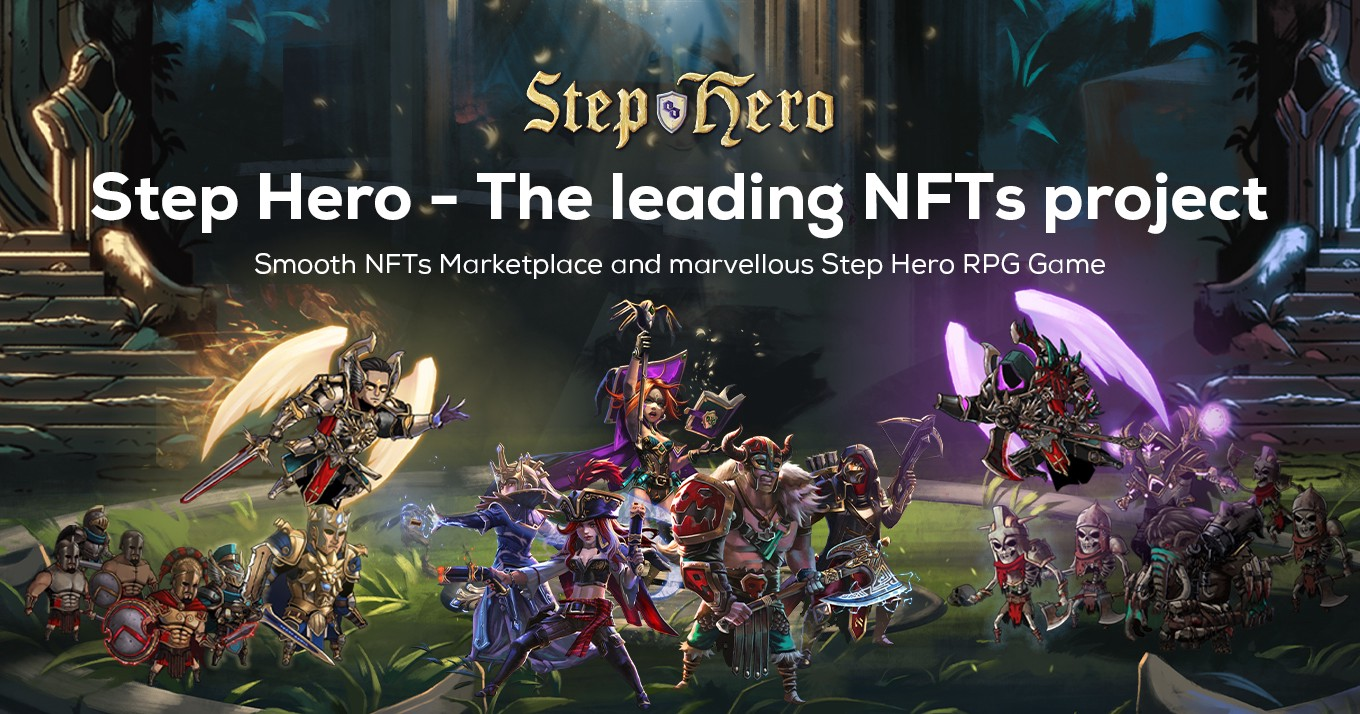
Game Step Hero is an online NFT role-playing game developed on Polygon and Binance Smart Chain. Recently, Step Hero has become a popular game because PvP mode allows gamers to have fun and make money simultaneously. In addition, players can also trade items and characters on the game's NFT Marketplace.
4. Cyclos (CYS)
On the Solana platform, Cyclos is an automated liquidity instrument (AMM) similar to Uniswap V3. Electronic asset transactions can come to life more quickly and at lower costs thanks to the Dapp Cyclos engine, which aids LPs (liquidity providers). Apart from that, LPs can set their price ranges in Cyclos for liquid trading. A large volume of trading does not devalue the product's liquidity and thus provides the best possible profit.
5. Curve Finance (CRV)
Michael Egorov founded Curve Finance, a decentralized exchange similar to UniSwap, in January 2020. There are no transaction fees, and CRV is built on the Ethereum (ETH) ecosystem. Liquidity Pool smart contracts will get used to facilitate direct trading of Stablecoin exchanges in the AMM mechanism. Stablecoin transactions on the CRV exchange will not be affected by ETH fluctuations like the Uniswap exchange.
Start your NFT journey with Remitano here!
Conclusion
Dapps have grown in popularity due to the rise of cryptocurrencies. We hope that this article has provided you with a better understanding of the future of Dapps and the areas in which they still need to improve.