This article will look at the different types of rewards crypto miners receive and workable strategies that can improve their mining incentives.
Some Crypto Mining Strategies
The Default Crypto Mining method
Bitcoins have been around since 2009. Its main feature is in the network's decentralized nature. Tackling fraudulent activities like double-spending while rewarding miners to participate in network maintenance. Miners on the blockchain all follow a Proof-of-work consensus known as the "Nakamoto consensus."
Following the consensus protocol, when a new block is found, a generous amount of hash power (in the form of electricity) is given up to the network, by miners, as proof of the work they put in, hence the name. The miners use this energy to try and reveal the hash value of the block. Like solving a math problem that doesn't require formula-based calculations, it depends greatly on luck. Whoever gets it or comes closest from below wins the reward.
With this consensus protocol in place, the security levels are high enough. The difficulty of tampering with a transaction that is already initiated is very high, nearly impossible. Anyone willing to do so must possess a big portion of all the hash power within the network, more than half.
Mining pools
Owing to the vast growth in the number of miners and their hardware sophistication, most miners rather form groups (crypto mining pools) to make the job smoother. The proof of work contribution will still be an individual thing within the group. And most pools give rewards based on hash contributions when they collectively mine a block. The reward stays within the pool.
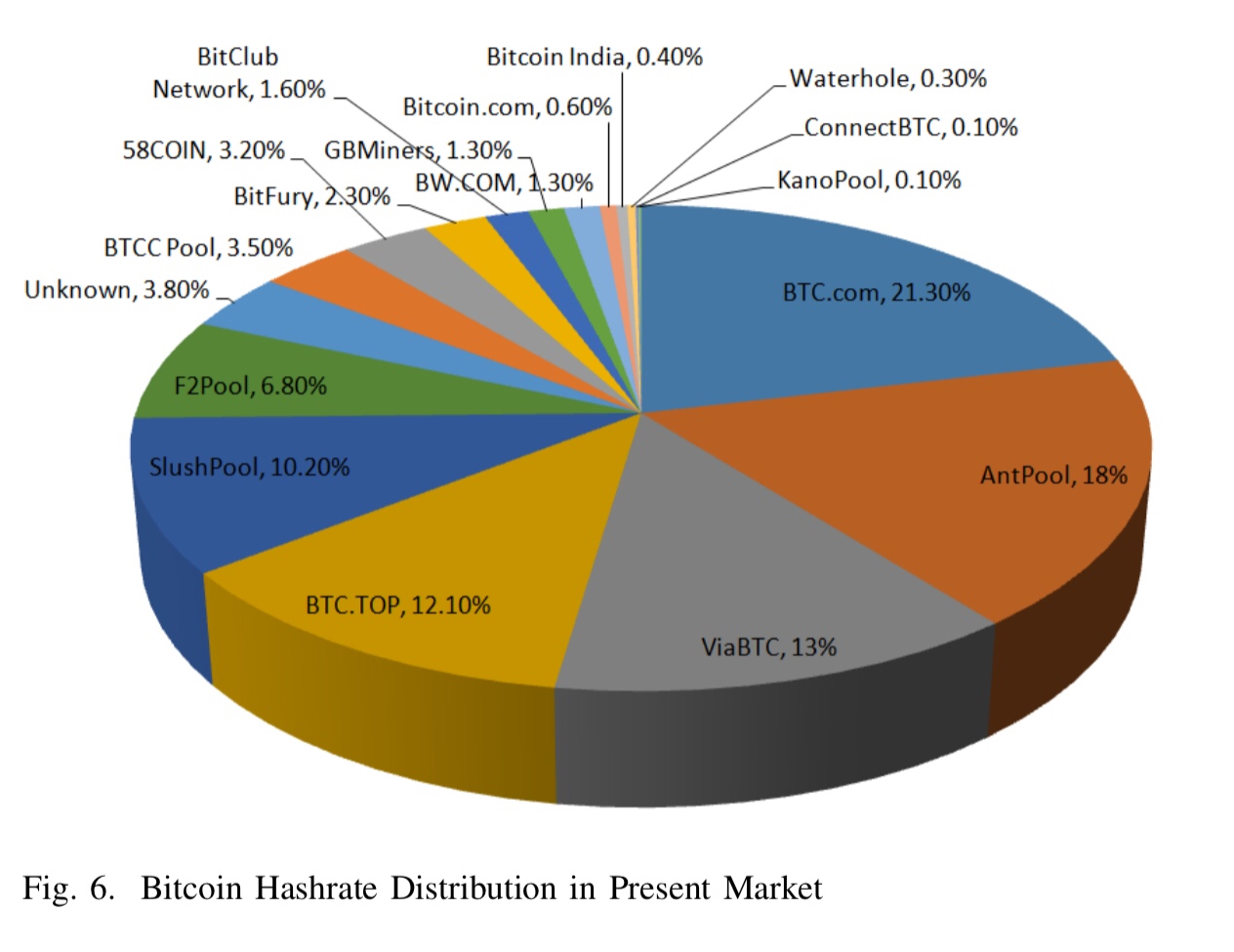
From the diagram, it can be observed that only five mining pools control over 70% of the total hash power produced.
Currently, the reward a miner stands to gain by mining individually isn't encouraging, and so joining pools increases their chances of getting rewarded. Depending on the miner's capacity, they assess the reward system of different pools and join whichever one suits them. There are different reward systems and among the common ones are:
Proportional
Here, the reward is split among pool members according to the shares of hash power they donated in mining that particular block. There are two types of donated shares; the Rejected shared and the Accepted shares.\
The accepted shares are those that contributed to the workload used in mining the block.\
The rejected shares are those that didn't contribute to the work.
This practice keeps the balance and fairness within the pool. For every miner in a pool, keeping a perfect number of accepted shares is quite impossible.
Maximum Pay per Share
Here, the accepted shares contributed by each member are rewarded with a fixed value already agreed on. The pool fees are usually higher because pool operators can't say how much will be disbursed in payment.
If the pool balance can't pay at the moment, then credit is stored for the user. Which may be paid later on when the pool has enough to do so.
Shared Maximum Pay per Share
This system is pretty similar to the rules of the Maximum Pay per Share system. The only difference is that the pay is going to be a percentage from the available balance only.
Score based
When using this system, shares submitted by miners are scored from the earliest to the latest. Each miner accumulates their score, and at the end, rewards are distributed in the final order.\
In comparison to the Proportional system, the variance here is a bit higher.
Different chains of transactions could be formed on the bitcoin network at any given time. Even from a single source, just like carbon chains in organic compounds. These contradicting chains are known as forks. Since these chains are usually products of competing miners, the miner who can get many miner blocks on his chain wins the loot. All other transactions outside of this chain are considered invalid until the next chain is formed. When a miner creates the first block in a chain, they can increase their chances of getting more miners behind them by leaving a juicy bonus for them. If the tip is sufficient enough, other miners can leave the current longest chain. Finally, go queue up behind the creator with the juiciest incentive with the hopes of making it longer.
The Forking Attack
This is another strategy that crypto miners can use to profit while keeping the coin from an initiated transaction. It is probably the easiest if you have enough hash power to pull it off and sneaky and dubious because it involves double spending of the same coin.
Let's assume that Mr. M wants to transfer some crypto to Mrs. B. He initiates the transaction, and it is added as part of the longest chain. If Mr. M is a dubious miner. He could duplicate this transaction and redirect the coins to himself instead of Mrs. B. To do this, he would have to add this new duplicate transaction under a different chain and try to make that chain having the new duplicate transaction as the longest chain, instead of the chain containing the original transaction to Mrs. B. This way, the duplicate transaction is confirmed first, and the original transaction is void forever.
 \
\
In theory, this attack sounds pretty easy, but in practice. It may be a lot harder to pull off since Mr. M. The dubious miner would have to somehow have up to half of all the hash power on the network backing him. It's possible to do this with even less, assuming most of the hash power is scattered among many other competing chains.
This attack is easily detectable, so the community can still reject the chain containing the duplicate transaction. Even if it happens to be the longest chain on the network. This will most likely be the case 10 times out of 10 since a successful forking attack would only hamper the integrity of Bitcoin. Pulling down the value, and invested miners that are in it for the long term would suffer huge losses.
The Goldfinger Attack
Named after the villain of a 007 movie that sought to plunge the value of all the gold bars held at Fort Knox by the United States of America government. This mining strategy also requires over half of the global hash power on the network.
With at least 51% of the entire hash power under control, the perpetrators will have the ability to double-spend at will. Destroying the integrity of Bitcoin, and inevitably, its value. The only viable motive behind this kind of trading strategy would be to kill the value of Bitcoin and possibly pump some other centralized coin that the miner has already invested heavily into.
Even at that, the cost of buying out over 50% of miners' hash power for a massive forking attack will probably be costlier. Bribing up that percentage is huge uncertainty. And they would have to be making way more from the bribe (most likely cash) than what they hold in their wallets or stand to gain by mining honestly in the long run.
Selfish Mining / Block withholding
Here, the miner finds a block, and instead of announcing it immediately and queuing up behind what they believe will be the longest chain. They withhold this block and try to mine on top of the block secretly. If they can get another one, they can release the both of them together and try to create a fork with an existing chain so that theirs will become the longest chain instead. As creators of the fork, they stand to gain more.
If the miner owns just one block and the network finds another chain, the miner has only one profitable option. Releasing the secret block as fast as possible and creating a fork with the equal potential of becoming the longest chain. At this point, they are better-off offering juicy incentives to miners for joining their fork and make it the longest chain instead. This type of mining strategy aims primarily to make more profit, hence the name; "Selfish mining."
 00
00
Punitive Forking
This mining strategy is not in any way profitable to miners at the moment. Still, considering a more centralized or heavily regulated crypto mining environment, it may come into play along the line.
Here, the miner refuses to mine on any transactions from a particular address, "X." They announce this, and anytime they come across that address in any chain of transactions. They would create a fork instead and try to make that one the longest chain. This strategy is only viable if controlled hash power is greater than 50%. That is why a better scenario would be under a more controlled mining environment where a controlling government can blacklist addresses belonging to Crime syndicates and Money launderers. Such a method is only short-lived as the owner can change bitcoin addresses from time to time.
Feather forking
This strategy is pretty much like Punitive forking, but it is considered a much better method of punitive forking. Here, the miner announces that they will create a fork because of a blacklisted address. But they won't maintain a permanent stand like with the punitive forking. Typically after one or two transactions are added to the original longest chain, the miner also switches back to the longest chain.
Switching sides after two confirmations is only reasonable when you have two blocks under your belt. Otherwise, a miner would switch after one extra block is added to the original chain since it means they will need up to three blocks to compete. Usually, other miners may need some kind of motivation to follow the fork, and if they consider the reward a lot more profitable than a single transaction's fee, then they will most likely be convinced.
Different types of Crypto Mining Rewards
Block Rewards

Every day the Bitcoin network processes as many as 300,000 transactions at an average of 4 transactions per second. These transactions are processed in blocks. Each block containing up to 1MB of transaction size, which can hypothetically be anywhere from one single to several thousands of transactions.
As a reward for processing these blocks of the transaction. Miners are given Block Rewards in new bitcoins released into the network. This reward system is set up so that the total loot is cut by half after every 210,000 blocks are mined, which takes an average of four years. This is a strategic means to preserve the coin's value by regulating total supply at a given time.
In 2009, when bitcoin was invented, the block reward was at 50 BTC. In 2013, it cut down to 25 BTC. The latest halving happened in May of 2020, and it cut the reward down to 6.25 BTC.\
The last block reward will be collected around 2140, at the current rate, and after that, miners will have their mining rewards mainly from transaction fees. At this point, transaction fees will most likely remain low as there will be a lot of competition for them.
Transaction fees

Transaction fees are another way of earning rewards on the network. Every transaction carries a calculated transaction fee. If the priority level of that transaction is above 0.576, then it is free. This is not really by choice of miners, and rather it is an encoding setting in the Bitcoin main client.\
A transaction's priority is calculated by summing the input value multiplied by input age and dividing through by the transaction size in bytes.
Priority = sum(input value × input age) ÷ size in bytes
In essence, this means that when you're moving older coins in large amounts with less complicated scripts, you pay less in transaction fees. If you move smaller amounts of your coins around quickly, then your fees will be higher. Seems like a procedure meant to encourage longer-term holding.
Miners could agree on a minimum transaction fee for any transaction processed on the network. But this will hardly be the case shortly as transaction fees barely make up 1% of the total reward miners receive. Even after the last block reward has been mined, there is still a chance that competition among miners will keep the fees stable. It is also possible that miners will push the enforcement of a minimum transaction fee, although this will need some form of centralization to be in play.
Bribes for Blocks and Hashpower

Although this doesn't happen very often, miners can get bribed to help propagate an ongoing fork by inserting their blocks. These bribes may be in the form of cash, or bitcoin tips have gotten as part of the block reward for a successful fork. It can be that the original chain contains a transaction from a blacklisted wallet address or that the miner wants more of the profit for themselves. Either way, they can be motivated to initiate a fork and bribe other miners to support them.
In another situation, the miner may have ulterior motives, like performing a Goldfinger attack or a "51% attack". They can proceed to bribe a large group of miners, most likely with cash rewards. And have them turn in their hash power to the cause. This could also be the case when performing a hard-fork, like with Bitcoin Cash and Bitcoin SV.
In Conclusion
Crypto mining is the backbone of the blockchain network, and without miners, nothing will function. The default mining and reward methods keep a fair network. However, some miners will always want to consider the value of Bitcoin and the number of resources they invested.
The method of mining widely adopted can either maintain or greatly harm the network. Certainly, miners will always gravitate towards a strategy that will make them more profit while maintaining the potential value of the gained profit.