The gas and fee structure update has been long-awaited and contentious.
Many people want it because it will help to reduce the amount of Ether in circulation. While miners are unhappy because it reduces their revenue.
Both parties are now waiting for the first results to see how the changes will affect the Ethereum network.
In this article, we'll go over EIP-1559 upgrade's five main highlights.
- What it means for Ethereum's fees
- What it means for gas prices
- Who stands to gain from it?
- What it has to do with ETH 2.0
- Whether or not it is a bullish sign for Ethereum
What it means for Ethereum's fees
The most controversial change of the Ethereum improvement proposal 1559 is on the fees structure of the network.
Previously, all the fees produced by the network, paid by people using Ethereum, would go to the miners. So, on top of the block reward , miners used to receive 100% of the fees in the blockchain.
The base fee is the standard price to make a transaction in Ethereum from now on.
A tip is any additional amount that a user is willing to pay to expedite a transaction.
The tip will be given directly to the transaction's validator. The base fee will be burned, and there will be no way to recover that Ether.
The Ethereum protocol will determine the amount of the base fee.
Validators, users, and other third parties have no say over how much the base fee is or will be.
The Ether contained in the base fee is permanently removed from circulation, and there is no way to reintroduce it.
It is a startling figure given that the update went into effect at the beginning of August.
Despite the fact that it hasn't even been a month, the amount of ETH destroyed has steadily increased, especially in the final section, as the NFT market heats up again.

Additionally, the value in US dollars of the Ether burned has climbed. First, because the amount of ETH destroyed has increased over time.
Second, due to the rise in the value of ETH in the same period of time.
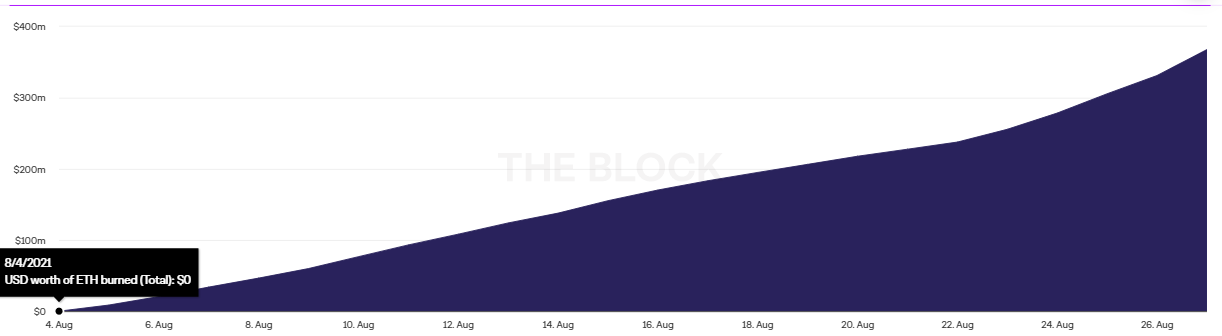
The above graph depicts the value of burned ETH in US dollars since the London Hard Fork.
As you can see, it steadily rises, in contrast to the amount of ETH, which fell between August 16 and 22.
The reason for this is that the price of Ether rose during that time period, more than compensating for the dip during those days.
The fee restructuring has been the most contentious aspect of EIP-1559. Most miners have been outspoken in their opposition, fearing that it will reduce their revenue.
Transition to PoS
The timing is also unfavorable, as Ethereum is transitioning to PoS, and most miners want to make as much money as possible before the switch.
It is too soon to tell whether the change has reduced mining profitability.
Although it has only been a month since the changes, preliminary evidence suggests that the impact has been minimal.
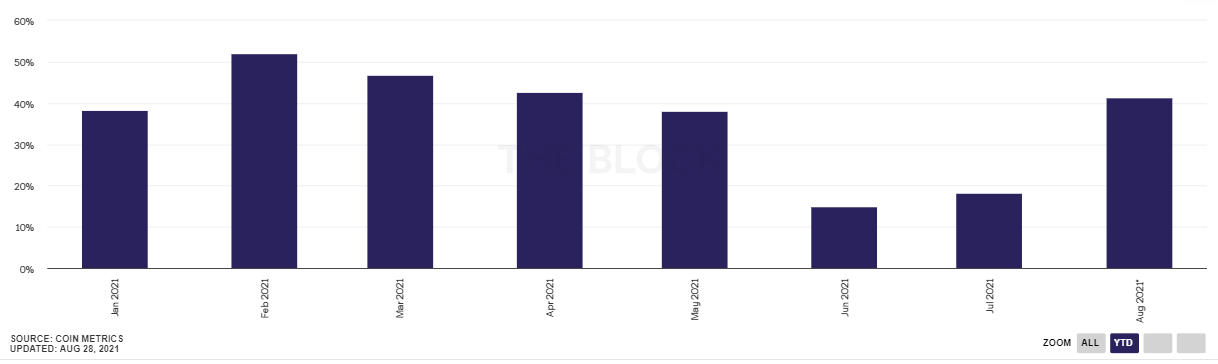
The above image shows mining profitability for the last eight months.
As we can see, the August bar has not been considerably shorter than any of the previous ones.
June and July are small due to the price drops during those months. For now, EIP-1559 is not eating the profitability of Ethereum mining.
Yet, it is still early to make a full judgment. As we have said, August has seen a new bull wave in the NFT markets.
So, Ethereum is once again experiencing a lot of transactions.
This could be compensating for the negative effects of the new fee structure, only time will tell.
What it means for gas prices
EIP-1559's second goal is to make gas prices more predictable.
The EIP-1559 mechanism was designed to create a more stable gas price market by requiring blocks to be 50% transactions.
Then, using those transactions as a foundation, update gas prices on a block-by-block basis.
Finally, the update allows blocks to double in size for a brief period of time.
Short-term demand can thus be met quickly without affecting transaction prices.
Gas prices will be adjusted on a block-by-block basis. If a single block is more than half full, the gas price rises by 12.5%;
if it is less than half full, the price falls by 12.5%.
Gas will become a predictable variable as the fix rises and falls, and wallets like MetaMask will be able to show how much a transaction will cost ahead of time.
Many people have been waiting for this change because prices were previously unpredictable.
Again, it is too early to tell if there will be a significant impact on gas prices.
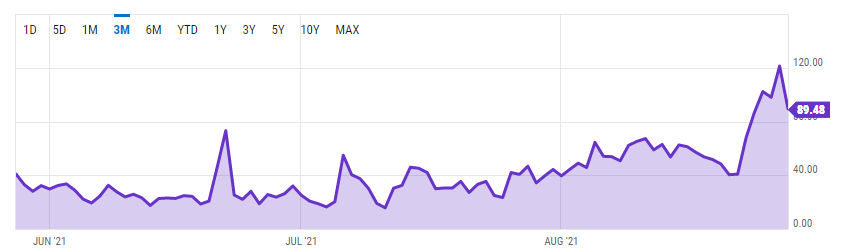
The rebound in NFT prices has made Ethereum transactions once again prohibitively expensive.
Any graph of current gas prices only shows them rising, making it impossible to determine whether the change had the desired effect.
 \
\
More information and time are required before making a final decision.
However, the update to make gas prices predictable is already in effect, and it appears to be working as intended.
Who stands to gain from it?
The benefits of EIP-1559 are intended for all Ethereum users. However, more time is required for the results to be conclusive.
The problems that miners are experiencing with the update do not appear to be occurring. Mining profitability remains within the average range and has even increased when compared to June and July.
The changes to how blocks work are intended to lower gas prices.
However, the August data show that prices are only rising, as a new bull market in the NFT sector drives transactions through the roof.
Even doubling the size of a block of gas has no effect on prices.
The only thing that is working as it should be is the predictability of gas prices. Crypto wallets can now clearly show how much a transaction will cost, which was previously not possible. EIP-1559 has been deemed a success solely in this regard.
What it has to do with ETH 2.0
As previously stated, EIP-1559 is part of the London Hard Fork.
The fork marks the first step in Ethereum's transition from a Proof of Work blockchain to a Proof of Stake blockchain. As a result, it is inextricably linked to Ethereum 2.0.
The EIP-1559 was designed primarily for use in a PoS network .
By burning the transaction fee, Ether becomes more scarce, and the price rises as a result.
Additionally, because the validators will lock a significant portion of the Ether in the network, the circulating supply of ETH will be reduced even further.
The ultimate goal is to convert Ether from an inflationary to a deflationary asset. According to some projections, more Ether could be destroyed in a year than is created by the network.
Whether or not it is a bullish sign for Ethereum
On the plus side, we have:
- Less supply of Ether: The base fee of any transaction is destroyed.
- More demand for Ether: People looking to speed up transactions will have to give a tip on top of the base fee directly to the miner. The result is more demand for ETH.
- Lower circulating supply: In the future, the PoS change plus the destruction of fees will make ETH a deflationary cryptocurrency.
But these changes can have negative consequences too:
- Liquidity crisis: In the PoS network, most of the ETH will be used by validators. Plus a large portion of ETH will be destroyed. Both can lead to a crisis where there is not enough Ether for the market to use and create a liquidity crisis.
- Reduced profitability: Ethereum 2.0 intends to be a faster network. As a result, fewer people will have an incentive to tip the validator to make a transaction faster. In time, this could reduce the profitability of running a validator node in Ethereum 2.0.
To sum up
Ethereum improvement proposal 1559 has gone into effect.
It has not even been a month since the change, but many are eagerly analyzing the results to see what the future effects could be.
Only time can tell if the changes are positive or negative.
Now is a good time to learn why Ethereum 2.0 matters, and how this development might affect ETH's value.