Key Takeaways
- Layer 1 network refers to the blockchain in a decentralized ecosystem.
- Examples of layer blockcahins range from Bitcoin to Litecoin and Ethereum.
- Layer 2 scaling solutions depend on secondary networks that function independently of the main chain or are parallel.
Many people worldwide are embracing cryptocurrency in several daily activities. From transactions to investments, it's hardly surprising to see how different users utilize this digital currency. This reality further emphasizes the importance of building blockchain layers for heightened network safety, data collection, and other purposes. This article will discuss scaling as an enhancing tool for blockchain networks, scaling solutions for both layers, and their differences. Let's go!
What Is Scaling In Blockchain?
Many users in the crypto world understand the several benefits of blockchain technology. They range from heightened network security to bettered data collection and smooth transactions. But another crucial element in blockchain solutions is scaling. Each blockchain network utilizes a decentralized system to finish layered transactions.
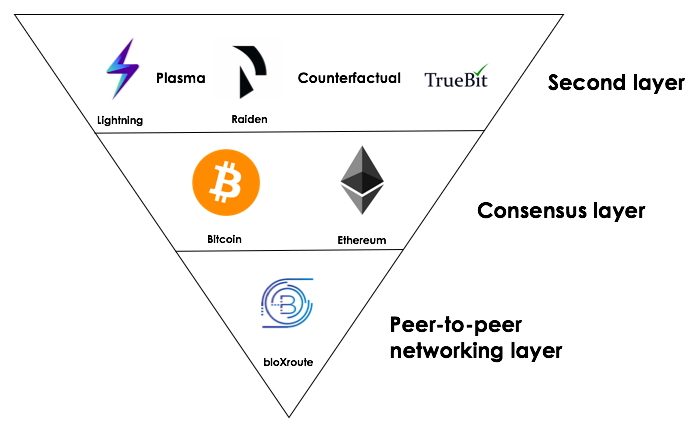
Source: Medium
As described above, scaling in blockchain refers to an increase in the decentralized system throughput rate. “Throughput” means the number of transactions a system carries out per second. Different technical discussions in the blockchain space have scaling as a central topic. It's arguably the single most discussed concept in that world.
Layer 1 scaling solutions
A Layer 1 network refers to the blockchain in a decentralized ecosystem. Examples of Layer blockchains range from Bitcoin to Litecoin and Ethereum. Most Layer 1 solutions support the blockchain protocol’s base layer for better scalability. Different mechanisms kept coming up and carried out to improve the scalability of blockchain networks. This means there are various open options for Layer 1, which can improve throughput and total network capacity.
For Layer 1, scaling could be improving the block confirmation’s speed or heightening the data-containing space of a block. But even with all these, this layer still seems to be lacking with the increasing amount of blockchain users. Blockchains using the Proof of Work consensus mechanisms are outdated and clunky. And while some might hold on to this mechanism because of its more secure nature, it lacks in its speed.
This is where the option of transitioning to the Proof of Stake mechanism comes in. This switch will not increase transactions per second (TPS) but also lessen processing fees. This method also endorses new transaction data blocks according to the staking collateral of the network's participants.
The extra workload in Layer 1 blockchains reduces processing speeds and spaces. As a result of the increase in the number of users, scaling problems arise. Sharding comes in as a solution here. In simple terms, sharding eases processes involved in transactions such as validating and authentications by dissecting them into little and doable pieces.
This way, the workload gets stretched across the network to take in computing power via more nodes. As a result of the network's simultaneous processing of these shards in parallel, sequential processing on several transactions can happen simultaneously.
Related: How to integrate Remitano Pay to Your Ecommerce Website
Layer 2 scaling solutions
For Layer 2 scaling solutions, many depend on secondary networks that function independently of the main chain or are parallel. This blockchain functions on the root layer to better its effectiveness. Layer 2 efficiently unloads transactions, takes a part of Level 1 blockchain’s transactional load, and then puts it on another system structure.
The Layer 2 blockchain then works on the processing burden and reports to Layer 1 to finalize results. Layer 1 becomes less congested because of the load sharing, improving its scalability and lessening transaction fees. Below are a few other effective solutions:
Nested blockchains.
Simply put, a nested blockchain is a blockchain within or built on top of another blockchain. The blockchain architecture here revolves around a significant blockchain that stretches a broader network while setting parameters for it. It's a solution that involves many secondary chains sitting on top of the leading blockchain, otherwise known as the “parent” blockchain.
As we hinted above, nested blockchains function according to the regulations and parameters set by the parent chain. There's hardly any interference by the parent chain in carrying out transactions. The only time it comes in is for necessary dispute resolution.
Daily activities get shared among “child” chains which return the processed transactions to the parent chain after finishing it off the main chain. An excellent example of the Layer 2 nested solution is OmiseGO’s Plasma project. It functions atop the Layer-1 Ethereum protocol to foster quicker and less expensive transactions.
Sidechains
You can think of sidechains as unhinged blockchain networks that carry their own sets of validators. This reality connotes that the smart connecting contract located on the significant chain doesn't verify the sidechain network’s legitimacy. In this case, there's a need to trust the sidechain and believe in its ability to operate correctly and control assets on the native chain.
Rollups
The most popular kind, known as Zero-knowledge rollups, collate off-chain Layer 2 transactions and submit them as a single transaction on the main chain. Here, legitimacy proofs come in to affirm transactions’ integrity. Assets stay on the original chain with an intersecting smart contract. This smart contract establishes the rollup is working as planned. This provides the safety of the native network with the merits of a reduced resource-centered rollup.
State channels
A state channel fosters two-way communication between a blockchain and off-chain transactional passages while bettering their total transaction capacity and speed. This connection happens with the help of a pre-agreed smart contract or a multi-signature. The transacting parties involved carry out a transaction or a batch of transactions off-chain without immediately reporting transaction data to the main chain.
The moment every transaction in the set attains completion, the final “state” of the channel is recorded to the underlying blockchain for validation. This method allows for better transaction speed and increases the network's overall capacity. Instances of state channels include The Liquid Network, Bitcoin Lightning, and Ethereum's Raiden Network.
The differences Between Layer 1 and Layer 2
- Layer 2 scaling solutions utilize off-chain services or networks for better scalability. While layer 1 solutions are alteration to the blockchain network's root protocol that enhances scalability.
- Offchains solutions used by Layer 2 boost scalability by breaking down and sharing the transaction ordering and processing workload. While alteration to the root protocol, used by Layer 1, like larger block sizes or mew consensus methods, can foster scalability.
Bottom Line
The inception of crypto came with the search for better scalability. This hunt led to the two-faced approach with Layer 1 and Layer 2 solutions. But this change is still ongoing - blockchain technology systems are still developing. Anyone with a broad interest in crypto must have heard about Layer 1 and Layer 2 networks. We hope with this article, we've helped you decipher the differences and the scaling solutions the two layers offer.