Project Bakong: Cambodia's Next-Gen Payment System | CBDC
Project Bakong is the world's first blockchain-powered retail payment system run by a central bank. Launched in mid-2019, the project already boasts thousands of users and millions in transactions.
Not often do Southeast Asian countries make waves when it comes to financial technology --- more so from a government-led initiative and a frontier market. And so it is all the more impressive to see Cambodia leading the way in the global central bank digital currency (CBDC) race.
Why Project Bakong?
Source: Soramitsu
On the front end:
- To improve financial inclusion, efficiency and safety, as well as promote the use of Cambodia's local currency, the Khmer Riel (KHR).
- Cambodia has a large unbanked population: only 22% of citizens above 15 have a bank account.
- Cambodia has a large remittance market: domestic money transfers are common yet still costly;
- The chronic lack of access to digital financial services means that the country is missing out on opportunities in the digital economy, especially in e-commerce.
- Cambodia's local currency is only available in small denominations, so people prefer to use the US dollar to settle large transactions. So with Project Bakong's digital currency, people will find it more convenient to transact in KHR.

Source: Project Bakong
On the back end:
- Promote interoperability between the many players within Cambodia's banking network---the central bank, private banks, and payment service providers---by providing a ready solution that can be integrated into their existing systems.
- A ready solution developed by the central bank also lowers the barrier to entry for smaller payment service providers, allowing them to participate without further investment in infrastructure development, regulatory compliance, etc.
- Cambodia does not have a Real Time Gross Settlement (RTGS) system typically used by modern banks. They use a national clearing system, where clearing and settlement happens twice daily between banks and for interbank settlements.
What is it and how does it work?

Source: Soramitsu
Project Bakong largely involves the development of a:
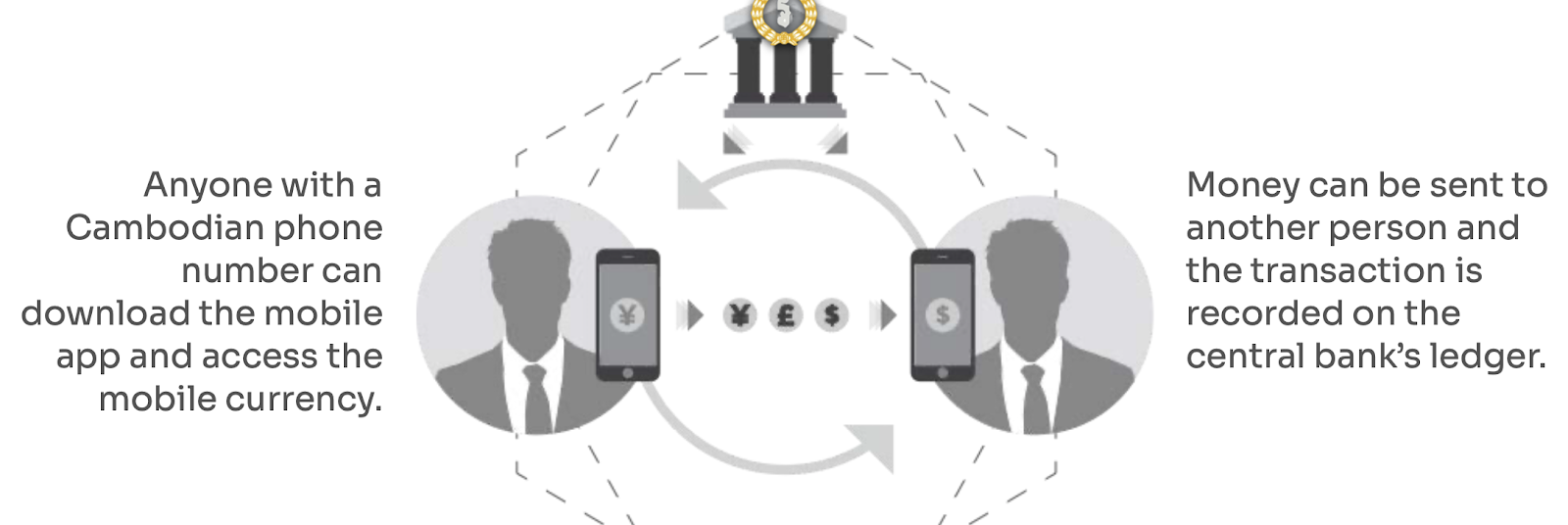
- Mobile application: for commercial bank clients to transfer money to registered users to an existing bank account (deposit). They can use a QR code, phone number, or account ID.
- Desktop application: for commercial banks to manage bank accounts
- Web client interface: for commercial banks to monitor clients' transactions, manage client limits, and generate reports
- Central bank retail settlement system:
- The National Bank of Cambodia runs the system and only they have access to all transactions
- The platform was developed using a two-tier architecture where the central bank provides an interbank ledger of all transactions and each commercial bank provides access to transact on the platform to their users
What is Project Bakong's expected impact?

Source: Project Bakong
- With the Bakong system, retail users can send and receive money using their mobile device.
- When a commercial bank or central bank links its system to Bakong, its retail users can send/receive money across borders;
- The National Bank of Cambodia foresees cost savings of over US$360 million annually. It is due to increased transaction efficiency and lower cash handling costs;
- Greater financial inclusion among Cambodian citizens; and
- Reduced risk of money laundering and illegal activity since the flow of digital currency can be tracked from creation till transaction completion.
Sources: Project Bakong, Soramitsu, OMFIF
Other articles in our CBDC series:
Maybe you are interested: