On 16 November 2016, the Monetary Authority of Singapore announced that it had inked a partnership with blockchain technology company R3 and some of the world's leading financial institutions. They want to figure out how they could make use of distributed ledger technology to benefit Singapore's financial ecosystem. The initiative was Project Ubin.
This was nearly three years before China announced that it had been working on a digital currency of its own. This made Singapore believe that Project Ubin could very well be the "first Asian digitalized currency".
And indeed it could be. While China is ahead in the retail central bank digital currency (CBDC) game, it has said that it is not looking to create a 'digital renminbi' but an all-new digital currency that would complement its existing currency. On the other hand, Project Ubin was looking to create a digital Singapore Dollar (SGD).
Let's start at the very beginning. In this article, we'll attempt to summarise, in plain English, everything you need to know about Singapore's CBDC Project Ubin.
What is Project Ubin?
1.) According to Project Ubin's first report, its overarching goals are to:
- Evaluate the implications of having a tokenized form of the SGD on a distributed ledger. Asset its potential benefits to Singapore's financial ecosystem;
- Significantly improve domestic payments and securities and transactions; and
- Reduce risks and costs for cross-border settlements of payments and securities.
2.) To this end, the Monetary Authority of Singapore (MAS) and its primary technology partner R3 began shaping Project Ubin by asking:
- Business case: Would distributed ledger technology help Singapore's financial services industry become safer, more efficient, and more competitive?
- Technology feasibility: Can distributed ledger technology provide significant advantages for the financial ecosystem in comparison to existing technologies?
- Economic viability: What are the economic implications of a central bank digital currency with widespread participation?
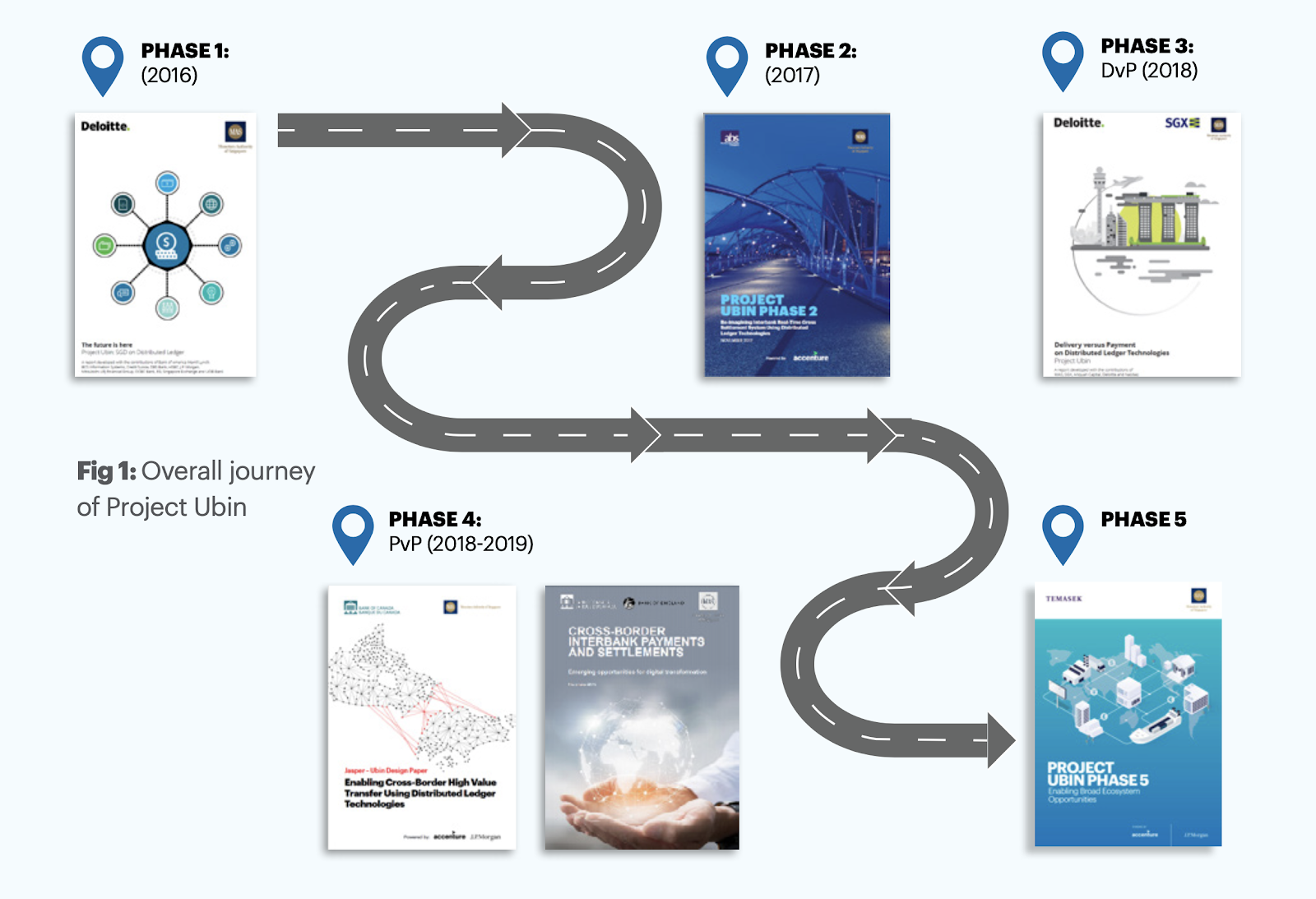
3.) They then decided that Project Ubin would be rolled out in five phases. To date, the project has engaged over 40 financial and non-financial firms including:
- Financial institutions: Bank of America Merrill Lynch, Citi, Credit Suisse, DBS Bank, HSBC Bank, JP Morgan, Mitsubishi UFJ Financial Group, OCBC Bank, Singapore Exchange, Standard Chartered Bank, and UOB Bank
- Technology partners: Accenture (project management), R3 (Corda), IBM (Hyperledger), ConsenSys (Quorum), Microsoft (Azure), Nasdaq, Deloitte, and Anquan Capital
Phase 1: Digitalizing the Singapore Dollar

4.) MAS decided to develop a prototype known as SGD-on-ledger. It was a digitalized, tokenized version of the Singapore Dollar with a specific use case: for making interbank payments.
5.) Three key design considerations underpinned the prototype:
- Unlike money in bank accounts, MAS would not receive interest on these holdings. The absence of interest calculations reduces the complexity of managing the payment system.
- To ensure full redeemability of the token for money, each token is fully backed by an equivalent amount of SGD held in custody. This ensures that the overall money supply remains unaffected by the issuance of these SGD-on-ledger tokens.
- These are limited use instruments, i.e. the SGD-on-ledger shall be used only to settle interbank debts to avoid misuse. The tokens were likened to coupon booklets at fun fairs: visitors can purchase them to be spent on food and games within the fun fair only.
Phase 2: Domestic interbank transfer

6.) The next step after creating the SGD-on-ledger (or Digital SGD) was to design a payment system for it to function in. To this end, MAS decided that it would challenge its partners to develop not one but three prototypes --- each built on a different distributed ledger platform: R3's Corda, IBM's Hyperledger Fabric, and ConsenSys' Quorum.
7.) Each team independently designed and developed their prototype while following the same set of six criteria.
- Payment digitalization: Central Bank Digital Currency with real-time gross settlement capabilities
- Decentralized processing: Distributed and resilient infrastructure with no single point of failure
- Payment queue handling: Uniform queueing system with prioritization, holding and cancellation facilities
- Transaction privacy: Only relevant parties will have visibility to transaction details
- Settlement finality: Final and irrevocable settlement of payment instructions
- Liquidity optimization: No payment gridlock to ensure efficiency in monetary flows
Phase 3: Cross-chain domestic interbank transfers
https://www.youtube.com/watch?v=VVjVaVm2_2I
8.) Once there was a tokenized Singapore Dollar and blockchain-enabled payment systems in which it could function, Project Ubin then asked: can the Digital SGD move across separate blockchains that were built with different functionalities and operated by different banks within the country?
9.) The answer is yes. In November 2018, the project enabled financial institutions to simultaneously exchange and settle digital currencies and securities assets despite their internal systems on different distributed ledger technologies by achieving cross-chain interoperability.
Phase 4: Cross-border interbank transfers
https://www.youtube.com/watch?v=8erKrL8cONE
10.) After figuring out how to make different systems within a single country work together, MAS then worked with the Bank of Canada and Bank of England to figure out how they could use distributed ledger technology to enhance cross-border interbank payments and settlements.
11.) Their joint report proposed three models of cross-border wholesale central bank digital currencies (W-CBDCs), with many pros and cons for each model listed:
- W-CBDCs that can be held and exchanged only in their home jurisdictions and not beyond;
- W-CBDCs that can be held and exchanged beyond their home jurisdictions; and
- A single, universal W-CBDC backed by a basket of currencies.
12.) Ultimately, the key challenge in creating a common international platform for cross-border payments relates to questions of governance and ownership. All central banks do not trust a single natural party to issue, maintain, and update their currencies and corresponding ledgers.
13.) Nevertheless, MAS and the Bank of Canada also linked up their respective experimental domestic blockchain-enabled payment networks---Project Ubin and Project Jasper---and conducted a successful experiment on cross-border and cross-currency payments using central bank digital currencies.
Phase 5: Commercial use cases
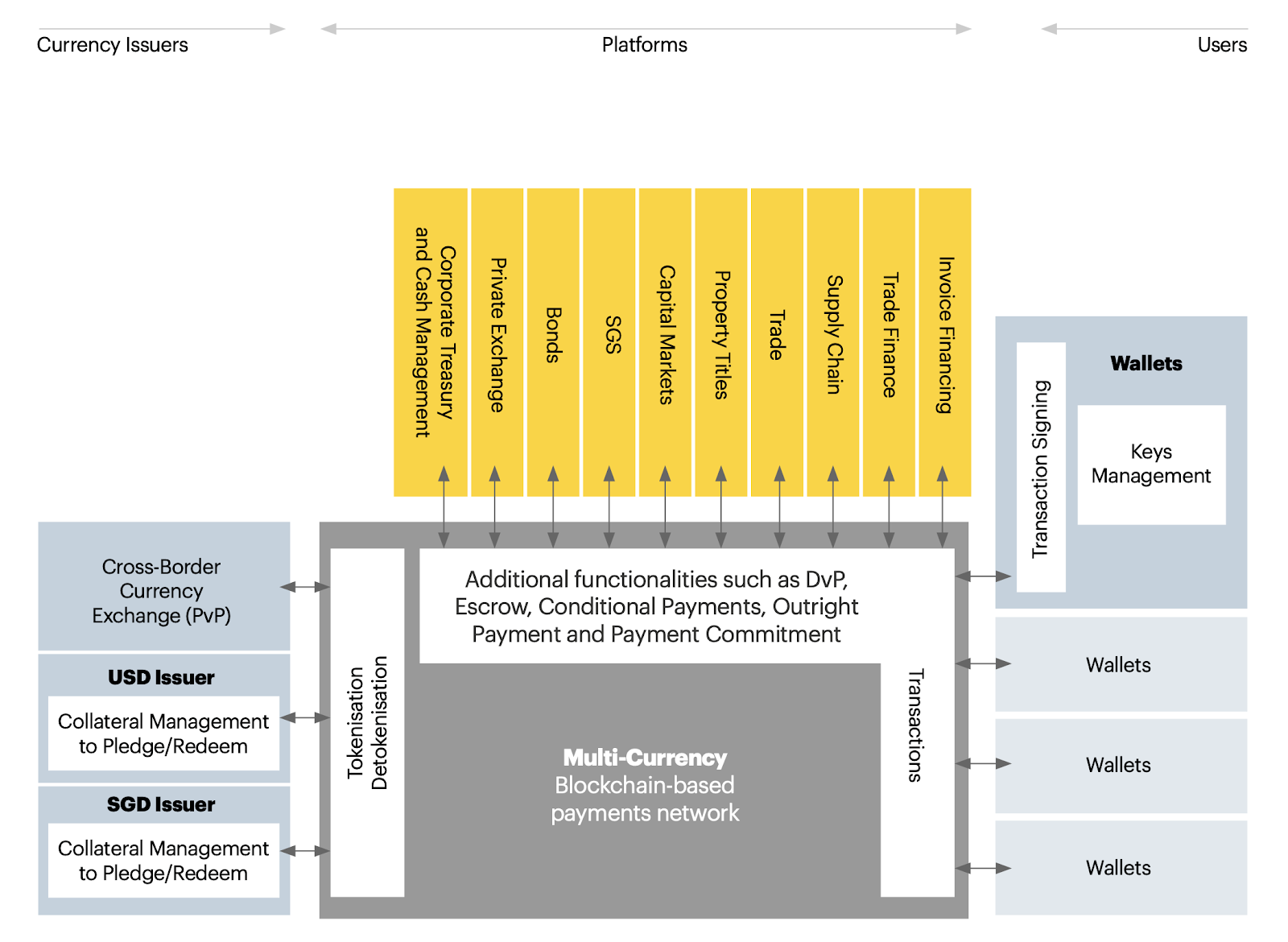
14.) Project Ubin aimed to develop a prototype blockchain-based multi-currency payments network that allows payments in different currencies on the same network and completed its final experimental phase, Phase 5.
15.) The team has developed the prototype "Ubin V" network and currently tests its commercial viability and ability to integrate with commercial blockchain applications in the industry
And those are the 15 things you need to know about Project Ubin. Download the Remitano mobile app (Android / iOS) and keep an eye on our Forum to stay updated on the latest developments on this project and other CBDC projects around the world.
Learn how governments in other countries are using blockchain and crypto: