Cryptocurrencies are struggling to gain mass adoption in recent days due to high volatility.
The cryptocurrency price can appreciate up to 20% or depreciate up to 20% within hours, leading to significant gains or losses.
Cryptocurrencies are struggling to gain mass adoption in recent days due to high volatility.
The cryptocurrency price can appreciate up to 20% or depreciate up to 20% within hours, leading to significant gains or losses.
Cryptocurrencies are not governed or managed by any central authority.
As a result of this, cryptocurrencies are regarded as a risky investment by some critics rather than a means of exchange.

For years now, experts have been seeking a solution to combat the issue of cryptocurrency volatility.
They came up with a solution called digital currencies (stablecoins) associated with real assets. They help in hedging in times of high cryptocurrency volatility.
In this article, readers will learn what stablecoins are, leverage them to avoid inflation on local currency, and start using stablecoins for international transactions.
They will also learn how to send and receive stablecoins through different exchanges and the various wallet addresses each stablecoin has.
Stablecoins are or digital money forms to mimic real fiat currencies or are associated with fiat currencies like the dollar.
They facilitate users to transfer money seamlessly and rapidly internationally while maintaining price stability.
Below are a few of the most popular stablecoins:
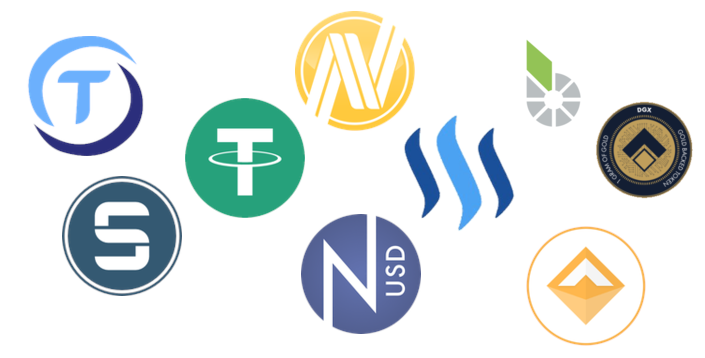
Tether is also associated with gold, a tether is very easy to integrate on cryptocurrency fiat exchanges, and its security protocol is very durable.
It also offers the trading of cryptocurrency and stablecoins against other trading pairs. It launched its stablecoin called BUSD, which is associated with 1:1 t to the U.S. dollar.
USD COIN: USD coin, also known as (USDC) is a stablecoin backed by one of the biggest cryptocurrency exchanges coinbase, USD coin by coinmarketcap data is the second-largest stablecoin
TRUE USD :TRUE USD, also known as TUSD, is a stablecoin that is solely associated 100% 1:1 with the U.S. dollar.TUSD is among the top stablecoins with low transaction rates and high liquidity.
TUSD is owned by TrustToken company, which has other stablecoins associated with other fiat currencies.
There are currently available types of stablecoins today on the cryptocurrency market, which different exchanges offer today.
We will be discussing them today and the kind of assets they are associated with.
Fiat associated stablecoins are associated with real fiat currencies, backed at a 1:1 ratio with real fiat currencies like USD AND EURO.
Commodity associated stablecoins are associated with assets like precious metals, gold, and oil.
Nonassociated stablecoins are not associated with any asset.

The advantages of saving in stablecoins are numerous. We will be listing the essential advantages of saving in stablecoins:
Stablecoin can act as a haven to protect your wealth against potential losses when such scenarios arise.
You don't have to worry during high depreciation when you notice high depreciation on the market and convert the underlying asset to stablecoin to avoid losses.
You can easily exchange it for your local currency. This process is by far better, faster, and easier than normal traditional means of receiving money,
Because stablecoins run on a decentralized blockchain, the waiting time and transaction fees are reduced drastically, compared to the average banking sector.
Real-world assets represent Stablecoins. For example, USDT is associated with the U.S. DOLLAR.
Stablecoins are used to pay for services across many platforms internationally, removing the barrier of having to pay high tax fees and numerous charges taxed on your bank credit/debit cards.

There are some standard rules to follow while using stablecoins, since stablecoins are digital virtual assets there are some rules and regulations to follow while using them
Before you can start using stablecoins you need a reputable exchange with high liquidity, where you can easily buy, sell, send and receive stablecoins and be able to exchange it easily to your local currency.
Before you will be able to send stablecoin internationally, the person you are sending it must have a receiving wallet address to receive the stablecoin you are to send to them, just like sending money to a local bank account.
You need that person's account number and bank name to send money to, whereas in the process of sending stablecoins you need the person's wallet address before you can transfer to them.
You can transfer to that person wherever he/she is in the world as long as you have the persons wallets' address.
Since there are various types of stablecoins, wallet addresses for each stablecoins, you will inform who you are sending the stablecoins to, the type of stablecoin you are sending to them.
So they will send you a corresponding wallet, because if you transfer TEHER (USDT) to TRUE USD (TUSD) wallet address, the stablecoin will be lost forever.
to avoid that make sure you are sending the corresponding wallet address to the sender, also some stablecoins have different forms of address for transferring funds let's use tether (USDT) for a case study.
Tether has three forms of wallet address to send and receive Tether.
They are USDT-Omni, USDT-ERC20, and USDT-TRC20.
To distinguish the types of wallet addresses:
Omni address: 3NNoERM7XrX8mLMdAgD27U2Fq7VGZr9QoG,
ERC20 address: 0xe0c8eac1006771e8e25c32c0101b875ba624ac39,
TRC20 address: TKUo9TEzjCR5Mw6pZTcafoNsDXkvhmTeq2,
Looking at the examples above, you can also clearly see the difference between these 3 types of wallets.
Omni wallet starts with a number, ERC20 wallet always starts with 0x, and TRC20 wallet starts with character.
So make sure you confirm the form of wallet address you are using before sending stablecoins, but that is for tether (USDT).
Other stablecoins have different forms of addresses, so confirm the addresses before sending and communicate to the sender the type of wallet you sent to him/her.

Here are the disadvantages of saving in stablecoins:
This raises trust concerns if the companies are backing every digitally issued fiat with real fiat since most of these entities have never provided any transparent audits of their reserves.
Hence, causing panic and leaving people suspecting these companies only hold a fraction of the real fiat.
For these doubts to be cleared, this fiat-based company should allow the third-party audits to confirm the total fiat they have in their reserves to boost trustworthiness among users and investors and strengthen their reputation in the market.
Fiat associated stablecoins undergo all regulations that accompany using fiat currencies, reducing the effectiveness of converting fiat-backed stablecoins, which causes lower liquidity than other cryptocurrencies.
Cryptocurrency represented assets associated with stablecoins are very complex to understand with highly complicated processes.
Cryptocurrency assets associated with other cryptocurrency assets make it easily more susceptible to price instability.
Suppose a fiat-backed stablecoin fails or is under crisis.
In that case, the fiat-backed stablecoin will lose value because they are closely related, and https://www.binance.us/en/home on a 1:1 ratio, this rule also applies to both commodity and cryptocurrency backed stablecoins.
Commodity assets associated with stablecoins are not liquid as any other stablecoins assets because they are hard to exchange into real fiat currency.
It increases fraud since it has no central body governing it.
Similarities of stablecoins and exchange platforms
Stablecoins share a lot of similarities. We will be discussing the similarities they share in this section.
They help in combating inflation rate during high market volatility movement and act as a hedging channel to save your fiat currency in case of currency devaluation.
They are majorly associated with real assets on a 1:1 ratio, golds, and cash equivalency.
They run on different blockchain technologies.
Stablecoins have different wallet addresses to deposit different stablecoins.
Cryptocurrency exchanges are platforms where you store your cryptocurrencies and stablecoins.
Cryptocurrency exchange platforms play the roles local banks offer.
They help you store it and keep it safe and for you. There are two types of cryptocurrency exchanges, centralized exchanges, and decentralized exchanges.
On centralized exchange platforms, there are sole custodians of your cryptocurrencies and stablecoins.
But on decentralized exchanges, the users are sole custodians of their cryptocurrency and stablecoins.