"Every improvement contributing to your outstanding experience is our daily motivation." -- Remitano.
When swapping, you need to pay attention to slippage tolerance to manage the coin pair's volatility. Since 14/12/2022, Remitano has launched a feature to set up slippage tolerance, which is highly convenient and easy to use, to best support users.
Table of Contents
1. What is slippage?
2. What is slippage tolerance?
3. What if you set your slippage tolerance too high or too low for a trade?
4. Tips to set Slippage tolerance
5. Guide to set Slippage tolerance on Remitano Swap
6. Conclusion
What is Slippage?
When your order is executed at a different price than expected, this is called slippage. Slippage usually occurs when the trading volumes of buyers and sellers differ significantly. Slippage can be either positive or negative, depending on the direction of price changes.
See also: What is the price impact? How are price impact and slippage different?
What is "slippage tolerance"?
Slippage tolerance is the adjustment of the price "movement" limit by the amount of coin you are willing to accept when trading a pair and is represented in the form of a percentage of the total swap order value. Put simply, it is the difference in the market price of the coin that you are willing to deal with if it rises or falls more than that price; if the market price of a coin changes more than that percentage, your order will be canceled.
For example, if you set the slippage tolerance to 2%, the coins you get can't be more or less than 2% of the amount you entered.
What happens if you set the slippage tolerance too high or too low for a transaction?
There is often a "sweet spot" for setting the slippage tolerance. This ideal amount varies based on each token, transaction, and personal risk tolerance.
Too High
When slippage tolerance is set high, the transaction can go through even if the price goes up or down, and this can open the door to front-running and sandwich attacks. A sandwich attack is a variation of front-running, where an attacker sees a pending transaction and then places a significantly larger transaction (with the same tokens) directly before and after the victim's transaction. In addition, this drives the price of the victim's transaction up, effectively allowing the frontrunner to extract the difference in value. Since the victim's slippage tolerance is so high, the attacker can get that much value from the attack.
Too Low
If the slippage tolerance is set too low, your swap order will be cancelled if the price changes unfavorably by more than this percentage.
Tips for setting Slippage tolerance
The best way to set the Slippage tolerance percentage is to start at the lowest (0.1 or 0.5%, for example) and then gradually increase until the operation is done. Depending on the token, the percentage may be 0.5, 1, 5, or even more than 10%, which you will only discover once you manage to carry out the operation with one of these percentages.
Usually, experts on the subject ensure that a low percentage in the slippage tolerance (between 0.5 and 7%) runs fewer risks than when setting other higher values, which usually vary between 8% and 16%. But it's important to note that depending on the type of operation you want to open, the percentage difference will make the platform automatically accept it since it will depend on how many assets you have available to do the swap.
Guide to set Slippage tolerance on Remitano Swap
Slippage on Remitano Swap is set to 1% by default, a safe rate that works with most coins on the market.
If you want to change this rate, follow these steps:
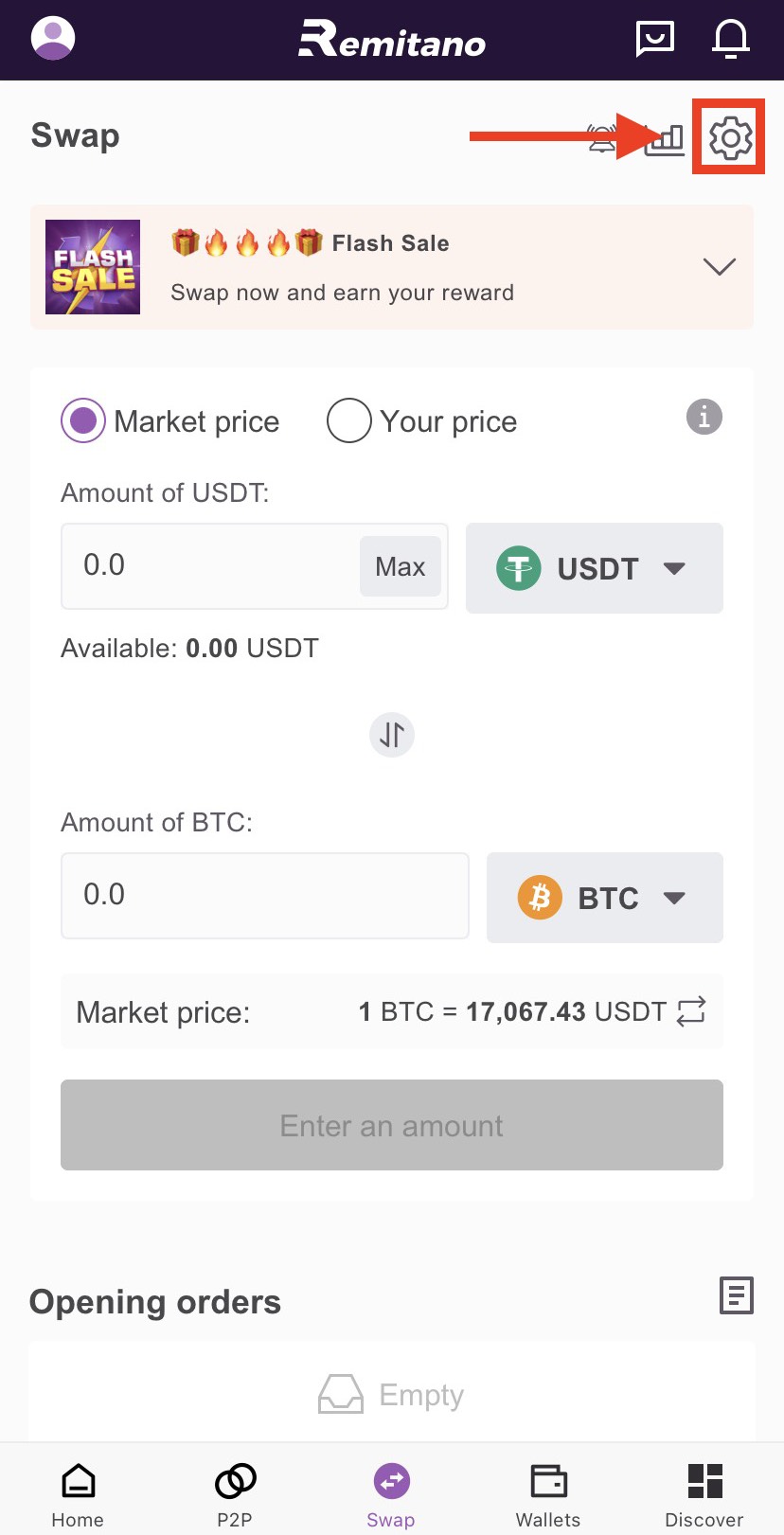
Step 1: Select the Settings icon at the top right corner of the Swap interface.
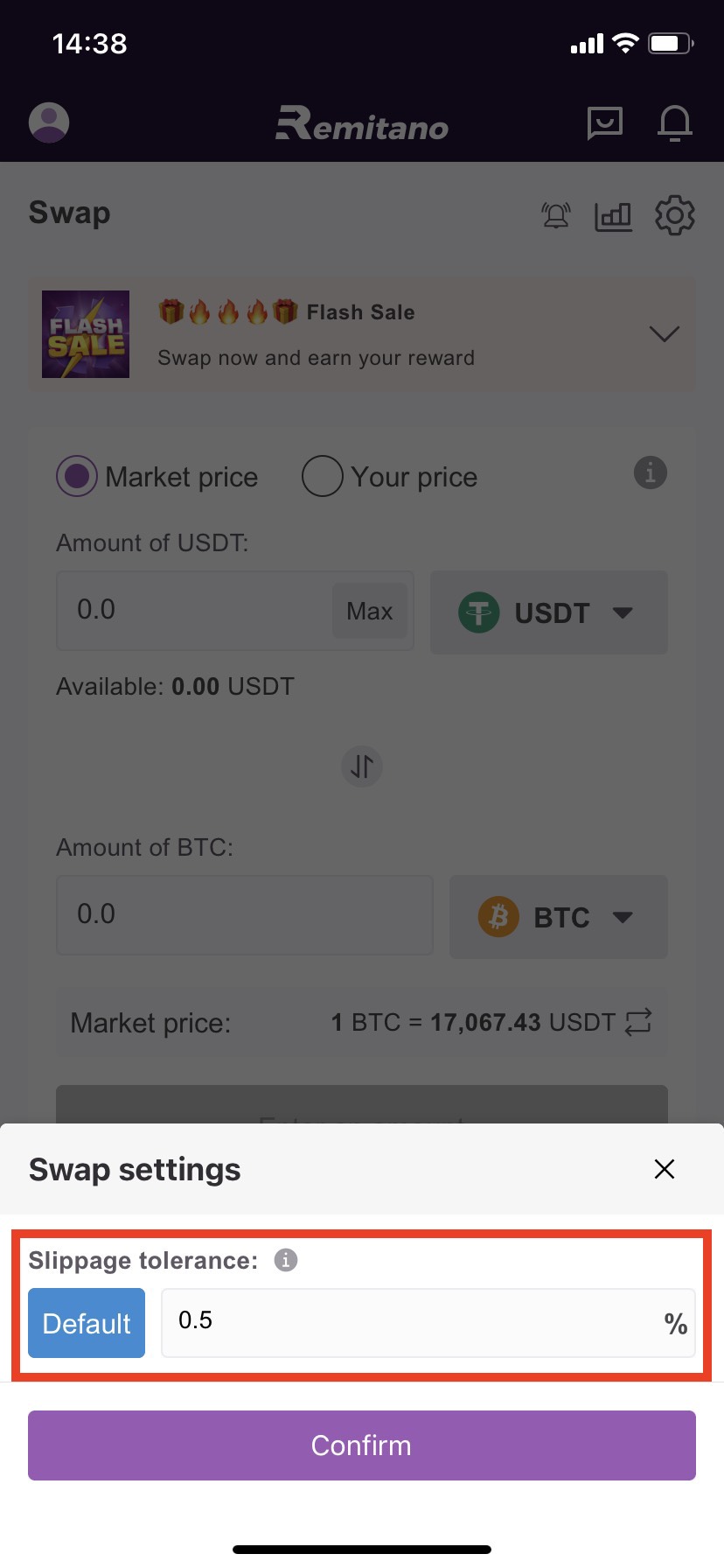
Step 2: Enter the desired Slippage Tolerance number.
Conclusion
Thus, Remitano introduced you to slippage, slippage tolerance, and tips for setting slippage tolerance when trading on the crypto market. With this new feature, you will gain better experience managing your transactions after each use.
Please note that this is only a reference article. The information in this article should not be considered investment advice. It would be best if you were responsible for your own decisions.
If you have any questions, feel free to comment below! Also, follow Remitano for the latest news, projects, and technical analysis knowledge in the crypto market.