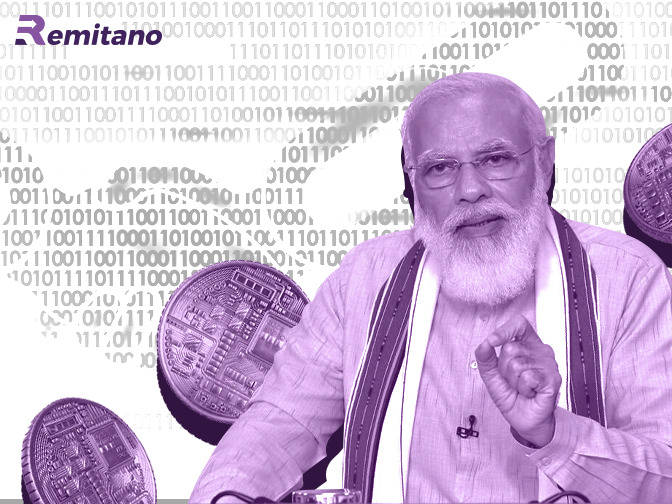
- Indian Prime Minister Narendra Modi has called for a unified global response to the problems posed by the growing acceptance of cryptocurrencies.
- Moody's is unhappy with El Salvador's Bitcoin trading experiment, but the president is unconcerned.
The Need for a Globally Coordinated Approach
On Monday, the Prime Minister spoke digitally at the World Economic Forum's Davos Agenda 2022, discussing a variety of problems, including the necessity for a worldwide approach to cryptocurrencies.
"The technology linked with it, as well as the judgments made by a single nation, will be inadequate to cope with its issues." "We need to think in the same way," he stated at the WEF meeting.
Cryptocurrency trading has recently gained pace in India, despite the fact that there are no industry controls or legislation in place to safeguard investors. The government's intention to introduce a law hit snags owing to extremely diverse perspectives of parties - banking sector regulators and representatives from the crypto industry.
Buy and sell crypto in 5 minutes.
"Cryptocurrency is an illustration of the kind of issues we face as a global family in the face of a changing global order."
To combat this, every country and global agency must take coordinated and coordinated action." Despite scheduling the proposed crypto law for debate in parliament at the winter session in December 2022, the government was unable to bring it up due to inability to take a position on key critical topics.
Although the authorities have not said why they failed to present the bill to parliament, sources indicate they have chosen to seek international help in developing a uniform policy on the issue.
In keeping with this stance, it is thought that the Indian government has asked the Bank of International Settlements (BIS) for assistance in developing laws for the crypto industry.
"When these institutions were founded, conditions were different, and now they are different," Modi remarked, referring to the difficulty of current international organizations to cope with new technology and changes in the realm of money and banking.
Several times in the last three months, the Indian Prime Minister has talked about cryptocurrencies at international events, but not once to home audiences in India.
Modi warned that developing technologies should be protected from exploitation in his remarks at The Sydney Dialogue in November 2021. In a speech at the Democracy Summit sponsored by US President Joe Biden in December 2022, he said that emerging technology should defend democracy rather than harm it.
During his WEF address yesterday, he reaffirmed this view. "That is why every democratic country has the obligation to put a focus on changes in these institutions so that they are capable of dealing with current problems in the future," Modi said at the World Economic Forum's Davos Agenda 2022.
Bukele Unconcerned by El Salvador's downgraded debt
According to Moody's Investors Service, El Salvador's Bitcoin trading activity is increasing the country's risk of default. President Nayib Bukele, like most other organizations who spoke out against the experiment, openly ignored their concerns.
Swap coins at a low fee.
Last Wednesday, the ratings agency spoke with Bloomberg about El Salvador's Bitcoin-related risks. Analyst Jaime Reusche said that the country's Bitcoin assets "definitely add to the risk portfolio," especially for a government that has already had liquidity challenges.
Since becoming Bitcoin legal money in September, El Salvador has been growing its holdings at every chance. According to the president's Twitter posts, the nation now has 1391 Bitcoin, which is worth around $58 million at the time of writing.
However, according to Moody's, the nation has lost $10-20 million on that position since purchasing it.
"If it rises significantly, it implies a much bigger danger to the issuer's repayment capabilities and fiscal profile," Reusche added.
According to the expert, El Salvador's failure to reach an agreement with the International Monetary Fund has elevated the country's danger of default. Due to the volatility of bitcoin prices, the IMF issued a statement in July opposing its use as legal cash.
Moody's is not alone in its negative assessment of El Salvador's debt. Due to a "deterioration in the quality of policymaking," the agency downgraded El Salvador's sovereign debt to "Caal" in July, signaling "extremely high credit risk."
President Bukele, as usual, seems unconcerned with the agency's assessment, being completely focused on Bitcoin. In a recent tweet in response to Moody's remarks, he said that El Salvador "DGAF."
Start crypto investing
Bukele has also exhibited apathy in the face of similar warnings from other groups. When the Bank of England voiced concern about the country's Bitcoin adoption in November, he argued that their concern was phony.
Bitcoiners were quick to point out in their responses that Moody's was the same company that granted exaggerated claims to dangerous mortgage investments before to the 2008 financial catastrophe - which Bitcoin's growth was heavily influenced by.