DeFi, therefore, represents "decentralized finance" and refers to a conglomerate of financial systems that are being made with, and designed to function on the blockchain tech. Although Ethereum is the most-widely supported to date.
DeFi tokens makes up a fast-growing space for DeFi systems developed on the blockchain ecosystem, and every now and then new DeFi tokens emerge to perform a new task or complement the effort of the earlier ones.
This looks simple enough but does not completely say what DeFi tokens are. So, what are DeFi tokens and what are they used for in the blockchain ecosystem?
DeFi Tokens: What they are and what they are used for?
DeFi tokens are decentralized financial applications based on blockchain protocols developed to mimic. But perform better than the traditional financial institutions like bank, mortgages, loan platforms, etc. Examples of DeFi tokens are Chainlink (LINK), Aave (AAVE), Dai (DAI), and Wrapped Bitcoin (WBTC). These all function on blockchains and enable seamless financial transactions on the blockchains.
DeFi tokens are developed to disrupt the conventional financial services sector and enforce decentralization. Removing third-party financial institutions like banks from transactions together with their associated challenges.
DeFi systems are a brainchild of Ethereum blockchain hence the majority of DeFi tokens today function by adopting smart contracts. So, just like people get loans, earn interest, trade (synthetic) assets, and perform other activities in normal traditional finance settings. DeFi tokens allow people to do the same on their own without relying on any third party like banks.
They are however not without a few setbacks the foremost of which is the problem of price volatility. Since they are tradable assets with high-risk investment characteristics.
Chainlink
With a circulating supply volume of 324,668,202.44 and a current market capitalization of $14,148,415,417 (Equiv. 254,022.80 BTC), Chainlink tops the list of Defi tokens ranked by market cap as of February 2021. Chainlink which is currently priced at $34.76 is powered by the Ethereum platform with the Ticket, LINK, and takes the #9 position on CoinMarketCap.
 \
\
Chainlink which is run on the Oracle protocol has an aggregate of 1,000,000,000 LINK coins in maximum supply. The available supply of the asset is 407,009,556 LINK coins, which is arguably the highest Defi token volume currently.
Chainlink is a non-mineable asset toke, hence is transacted on several ChainLink Token Markets and exchanges including Bybit, Binance, OKEx, Huobi Global, BiKi, and many others at varying exchange rates.
Uniswap (UNI)
Uniswap (UNI) is one of the high-potential DeFi tokens in the blockchain market today. With a maximum supply of 1,000,000,000 UNI coins and a 301,233,344 UNI coins circulating supply. Uniswap currently takes up position #3 on CoinMarketCap and is the second most popular Defi coin today. The market capitalization of Uniswap is USD 7,180,798,664 while the token has a trading volume of Uniswap $1,248,306,347.
 \
\
Uniswap which original name was Unipeg was made by Hayden Adams and floated in November 2018 operating on the Ethereum framework. The core objective of Uniswap is to leverage the possibilities of Ethereum's AMM to further decentralize, open, and automate trading. Activities of decentralized finance (DeFi) systems on the blockchain with a higher level of efficiency.\
Click here to get Uniswap (UNI) wallet.
Uniswap is set to solve liquidity problems associated with tokens pairing. Limit transactional risks and reduce the operating costs of transacting on the blockchain so that all parties can benefit maximally. Besides, it seeks to remove the requirements for users' identity authentication.
Wrapped Bitcoin (WBTC)
CoinMarketCap ranks Wrapped Bitcoin (WBTC) at position #15, with a market cap of $6,863,748,112 USD. Officially launched as a brainchild of The Wrapped Tokens project on January 31, 2019, Wrapped Bitcoin currently has a current market supply of 123,442 WBTC coins with an unknown or unavailable maximum supply figure.
The founders of WBTC are three organizations namely Kyber Network, BitGo, and Ren.Wrapped Bitcoin. Like other DeFi tokens trades favorably on top exchanges like Coinbase Pro, Binance, HitBTC, OKEx, and Huobi Global amongst others.
 \
\
Click here to get the Wrapped Bitcoin (WBTC)wallet.\
Wrapped Bitcoin (WBTC) runs on Ethereum and combines the power of Bitcoin's liquidity with Ethereum's financial decentralization capability. It utilizes the ERC-20 standard to allow for easier and quicker exchanges, wallet transactions, and digital payment services. So, rather than running a node for ETH and another (separate) node for BTC networks. One can leverage the power of WBTC to perform both operations using a single Ethereum node. This makes WBTC unique from other tokens on the Defi platform.
Aave (AAVE)
If lending and/or borrowing of cryptocurrencies are what you would like to do. Aave is widely believed to be one of the DeFi assets that can enable you to accomplish this seamlessly. AAVE (interpreted "ghost" in Finnish) which original name was ETHLend on its inauguration in November 2017is an Ethereum-based token developed by Finnish StaniKulechov. StaniKulechov created this token to solve the attendant issues of cryptocurrency crediting on the Ethereum space at the time.
 \
\
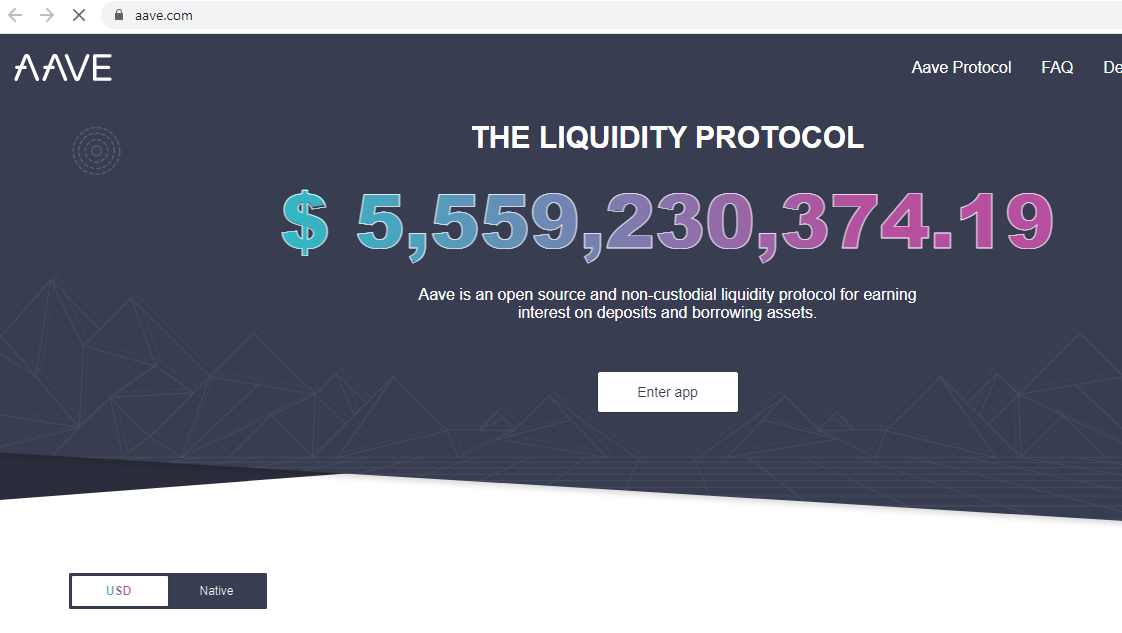
ETHLend was renamed to become Aave in September 2018 and has remained yet unchanged. The token has a market capitalization of $5,485,430,399 and is ranked #16 on CoinMarketCap. AAVE has a maximum availability of 16,000,000 AAVE coins and its circulating supply stands at 12,387,098 AAVE coins.
Click here to get Aave (AAVE) wallet.\
Aave which is a highly decentralized finance system rewards lenders with interests whenever they deposit digital assets into the liquidity pools. That are specially created by AAVE. To get a "flash" loan from these AAVE liquidity pools, a borrower would have to exchange or lease his/her cryptocurrency (s) as collateral.
There are several crypto exchanges both decentralized and centralized on which interested buyers and sellers can trade and/or exchange AAVE. Some of the top exchanges which support trading in and exchanging of Aaveare HBTC, Binance, CoinTiger, Huobi Global, and OKEx to mention a few.
Avalanche(AVAX)
Avalanche (AVAX)\
with a market cap. Of 3,046,796,925 is one of the Defi tokens which run as a decentralized platform through which people can transact assets like money, arts, and intellectual properties. The token is digital application for the global exchange of digital assets using smart contracts or similar technologies. Supported by decentralized architecture on which DeFi tokens are managed.
valanche was founded by EminGuiSirer alongside Kevin Sekniqi and Maofan Ted Yin each of which are renowned experts in their various fields. In September 2020 Avalanchemainnet was established and has been in operating successfully since then.
Certainly, what makes Avalanche stand out from the rest of the Defi tokens is its acceptance of anyone with access to it to launch, trade networks, and confirm transactions within the blink of an eye without the need for a third-party traditional financial institution like a bank. Avalanche uses AVAX as its local token for carrying out tasks such as the paying of interests and rewarding systems within it.
Click here to get Avalanche (AVAX) wallet. In protecting the platform from security breaches, Avalanche uses the proof-of-stake (POS) network that has low attack cost. At present, the price of Avalanche is at $38.87 and supply at the maximum of 720 million AVAX, with a circulating coin's supply of 76,937,055. Currently, Avalanche may be traded or exchanged on centralized and decentralized exchanges including Houbi and Binance.
Terra (Luna)
This is a blockchain based asset which provides stable payment systems through fiat-pegged stable-coins. An example of a popular fiat currency used by Terra is US Dollars (USD).
Against this backdrop, Terra which market cap is 2,821,656,292offers efficient and easy settlements by combining relative stability offered by Ethereum. In fact, with the time-tested and validated censorship-prevention which Bitcoin offers.
First developed by Daniel Shin and Do Kwon in 2018, Terra began to offer stable-coins pegged to different currencies and international bodies worldwide two years later, in September 2020 precisely. This was and is still done using the system's native token (a.k.a Luna) to stabilize the price of the stable-coins protocol.
 \
\
Terra is unique among the DeFi tokens mostly because it uses an algorithm that can adjusts stable-coin supply using fiat-pegged stable-coins. This allows Luna holders to profitably transact from stable-coins exchange rate and earn good interest on the Luna transactions.
Although the maximum supply of Terra is not yet available, Terra's tokens are put at 1 billion with circulating coins supply at 436,167,365 Luna, the Luna is available on trading apps like Houbi and UpbitMaker.
Maker
MakerDAO is the company that developed the Maker DeFi coin. The company was founded in 2015 by Rune Christensen. The system started operation in December 2017. The main task of the maker is operating the DAI (a community-managed decentralized cryptocurrency.
In summary, the decentralized organization, Maker DAO, and the software system, Maker Protocol uses Maker as a protocol in governance, derived from the blockchain of Etherum (ETH). This DeFi token gives enables users to transact the stable-coin, DAI on the ETH blockchain.Maker market capitalization Is 2,604,609,178.
 \
\
In October 2020 DAI became one of the frequently used stable-coins and the 25th largest cryptocurrency with a market capitalization of over $800 million. This DeFi coin's uniqueness is that it allows maker holders to participate directly in the operations of its stable-coin, DAI.
Maker is an ERC-20 token secured by Etherum blockchain, which uses the proof-of-work for securing its networks. Maker is available for trading at top exchanges such as HBTC, OKex, Binance, BiKi, and Houbi Global. The current market availability of Maker is around 1 million MKR coins while the maximum availability of the token is 1,005,577 MKR coins. Download Maker wallet
Synthetix
Synthetix is an off-shoot of Etherum like other DeFi coins. However, this DeFi coin is based on the liquidity pools system for the circulation and transaction of synthetic assets. Synthetix comprises ERC-20 tokens that track external asset prices. Many Synths are housed in a Synthetix and these include cryptocurrencies, conventional money and other relative assets.
 \
\
The DeFi token is a product of smart contract infrastructure rendered in the value of Synthetix Network Token (SNX) which acts as collateral. Initially, Synthetix called, "Havven" when it was floated in late 2017.
It has a network of tokens which support transaction such as the remittance of transactions, loans, payment as well as trading from others. Engaging on the Synthetix platform is not fruitless as the stakers with Synthetix are rewarded for supporting the system through their activities on it.
Presently, you can buy, sell, invest and flip (exchange) Synthetix on top exchanges like Dsdaq, OKex, Binance, Houbi Global, and HBTC. You can store your Synthetix tokens in your Synthetix wallet\
for these transactions. The DeFi token has a maximum supply of 212,424,133 SNX and a market supply of 114,841,533 SNX.
Dai (DAI)
The history of Dai (DAI) is traceable to Danish entrepreneur and Alma Mata of the University of Copenhagen, Rune Christensen who founded the DeFi platform Maker, MakerDAO in 2015. Like other DeFi systems, DAI is developed on Ethereum(ETH). DAI is credited as the first stable-cointo be developed based on Ethereum. Although the maximum availability of Dai is yet unknown, CoinMarketCap ranks Dai #41, with a market capitalization of $2,337,469,339.
 \
\
Dai is operated on the Maker systems and currently, the current market availability of the token is put at 2,334,516,227 DAI coins. It is neither owned by an individual or group of people, rather it operates as a democratized, autonomous. And a decentralized entity that leverages the power and benefits of ETH's smart contracts in its operations. This is done using software protocol to manage (i.e., issue and/or burn) all instances of DAI publicly.
Click here to get Dai (DAI) wallet.\
There are two types of Dai tokens namely the Single-Collateral and the Multi-Collateral DAI. On SAI, the preceding version of DAI, only one cryptocurrency may be used as gurantee on the blockchain. On Multi-Collateral DAI, collateralization of multiple cryptocurrencies is allowed. Besides this, Multi-Collateral DAI enables holders of DAI tokens to earn good savings for holding it. A situation known as the DAI Savings Rate. SAI, on the other hand, does not allow this. This shows that Multi-Collateral DAI is of more advantage to a user or investor who is interested in investing, trading, or buying DAI than the Single-Collateral DAI (SAI).
Therefore, if you want to buy DAI tokens, kindly visit any of the DeFi token swap protocol platforms like Compound, and Uniswap. Alternatively, you may exchange the cryptocurrency on marketplaces like Binance, HitBTC, OKEx, and Coinbase Pro.
Compound (COMP)
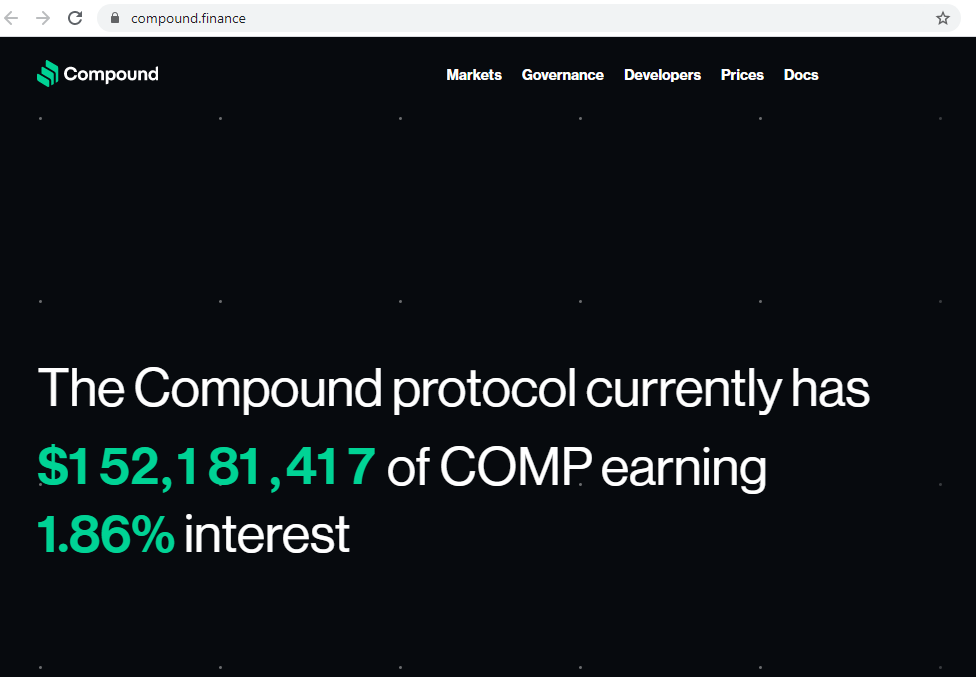
So, Postmates Ex-employees, Robert Leshner and Geoffrey Hayes together created Compound Labs, Inc. and founded Compound (COMP) in 2017. Compound (COMP), a token of immense potential has a maximum supply of 10,000,000 COMP coins and is currently ranked at position #43 on CoinMarketCap. The token has a market capitalization of $2,270,769,210 USD and a circulating supply of 4,611,498 COMP coins.
 \
\
Compound (COMP)DeFi tokens that run on the Compound protocol perform functions similar to Aave (AAVE) by allowing people to lend and/or borrow cryptocurrencies via the platform. So, to earn interest (which comes in the form of (Tokens), a user would deposit his/her cryptocurrency into any of the numerous COMP pools.
There are several pools for different cryptocurrencies like ETH pool, BTC pool, BNB pool, DOT pool, AND pool, etc. It is the same cToken(a representative of a stake in the given pool) that a user deposited that he/she would use to redeem the cryptocurrency he/she earlier deposited in COMP's pool.
What this means is that you cannot, for example, deposit ETH and redeem BTC or BNB. No. Rather, you will receive the cToken interest (or value) that corresponds to the cryptocurrency that you deposited into the pool.
Click here to get a Compound (COMP) wallet.
Comp and its token
The beautiful thing with COMP is that the exchange rate of the cTokens it issues its depositors appreciates with the underlying asset. Hence, on the redemption of the cTokens, a user would end some appreciable interest on the underlying asset than he/she initially deposited in the pool.
On the other hand, if you wish to borrow (i.e., take from) the pool, you will have to deposit collateral asset that complies with an applicable maximum loan-to-value (LTV) ratio usually pegged at 50% to 75%.\
The asset borrowed is used to determine the interest rate to be paid by a borrower.
There is a maintenance threshold specified for borrowers below which a borrower can face automatic liquidation if his/her collateral falls below this maintenance threshold.
Conclusion
The monopoly in the traditional financial services of local and world economies set the tune for a decentralized cryptocurrency token. To be developed which can leverage the power of the already existing blockchains. To cause further disruption in how people transact business across the globe. That is how and why DeFi tokens.\
Ever since DeFi tokens came into existence, people from around the world can now earn interests, trade (synthetic) assets. And even take loans from established and new blockchain-based technologies.
Finally, this is amazing and is a highly welcome development. It can only get better with the way things are going. DeFi tokens are arguably the new normal in the blockchain ecosystem and more of its potentials will unfold with time.