As we edge closer to the 2020 United States Presidential Election set to be held on November 3, we thought we'd take a closer look at what both Democratic and Republican candidates in the race have said about Bitcoin, crypto and blockchain.
Donald Trump (Republican)

Source: AP
The Don. The Donald. The leader of the free world. The sitting President of the United States of America. The presumptive Republican nominee for the 2020 presidential race.
Unfortunately for us, President Trump is as much of a fan of Bitcoin and cryptocurrencies as he is of CNN. Here's what he thinks of Bitcoin:
Going after Bitcoin
Most recently, a Forbes article about Trump's former national security advisor John Bolton's new book revealed that Trump told his Treasury Secretary Steven Mnuchin to "go after Bitcoin".
On Bitcoin's value and volatility
It's no surprise, of course, since Trump has also said that Bitcoin (BTC), crypto and blockchain, in general, have no value. Here's what he said:
"I am not a fan of Bitcoin and other Cryptocurrencies, which are not money, and whose value is highly volatile and based on thin air. Unregulated Crypto Assets can facilitate unlawful behavior, including drug trade and other illegal activity."
Well, we can't say there's no truth to that, though the President's critics could argue that Bitcoin has been no more volatile, and perhaps even more valuable than his time in office so far.
On Facebook's Libra
He's not a fan of Facebook's Libra either, saying:
"Facebook Libra's "virtual currency" will have little standing or dependability. If Facebook and other companies want to become a bank, they must seek a new Banking Charter and become subject to all Banking Regulations, just like other Banks, both National and International."
He's not the only one who isn't a fan of Facebook's Libra. After launching Libra in mid-2019 with the goal of creating a "simple global currency", Facebook back-pedalled in 2020 and said that it would instead create "digital versions of government-backed currencies". (What's the difference? Find out here.)
On the US dollar
President Trump goes on to say that the US dollar will always be the most dominant currency globally, an assertion that fans of the "digital dollar" (USDT) will certainly be happy to support.
"We have only one real currency in the USA, and it is stronger than ever, both dependable and reliable. It is by far the most dominant currency anywhere in the World, and it will always stay that way. It is called the United States Dollar!"
Having said that, many believe that unless the United States works on creating an official digital currency of its own ASAP, it runs the risk of losing the digital asset race to China, who has not only created its own Central Bank Digital Currency (CBDC) but is already testing it in key institutions across the country.
Joe Biden (Democrat)

Source: AP
Not much is known about how Uncle Joe feels about Bitcoin, crypto and blockchain. The former Vice President of the United States has largely shied away from technology-related topics, though political analysts say that he has mostly been supportive of new technologies and innovation. But will Bitcoin be far too radical an idea for him? Only time will tell.
So far, the only indication we have is from a fundraising group (known as a political action committee or PAC; entities that are independent and in no way linked to the campaigns they support) which supports Biden began accepting donations in Bitcoin. According to the group's director, they do so to keep with Biden's "strong support of technology and innovation throughout his career."
Also, a survey found that 5,213 of voters who say they will vote for Joe Biden in the 2020 elections do not think that the government should classify Bitcoin as a legal currency but should instead classify it as a commodity.
Other Democratic candidates
Much of this year's race has been dominated by the democrats, what with their roster of 29 major presidential candidates as opposed to the five major presidential candidates fielded by the Republican side.
Source: Getty Images
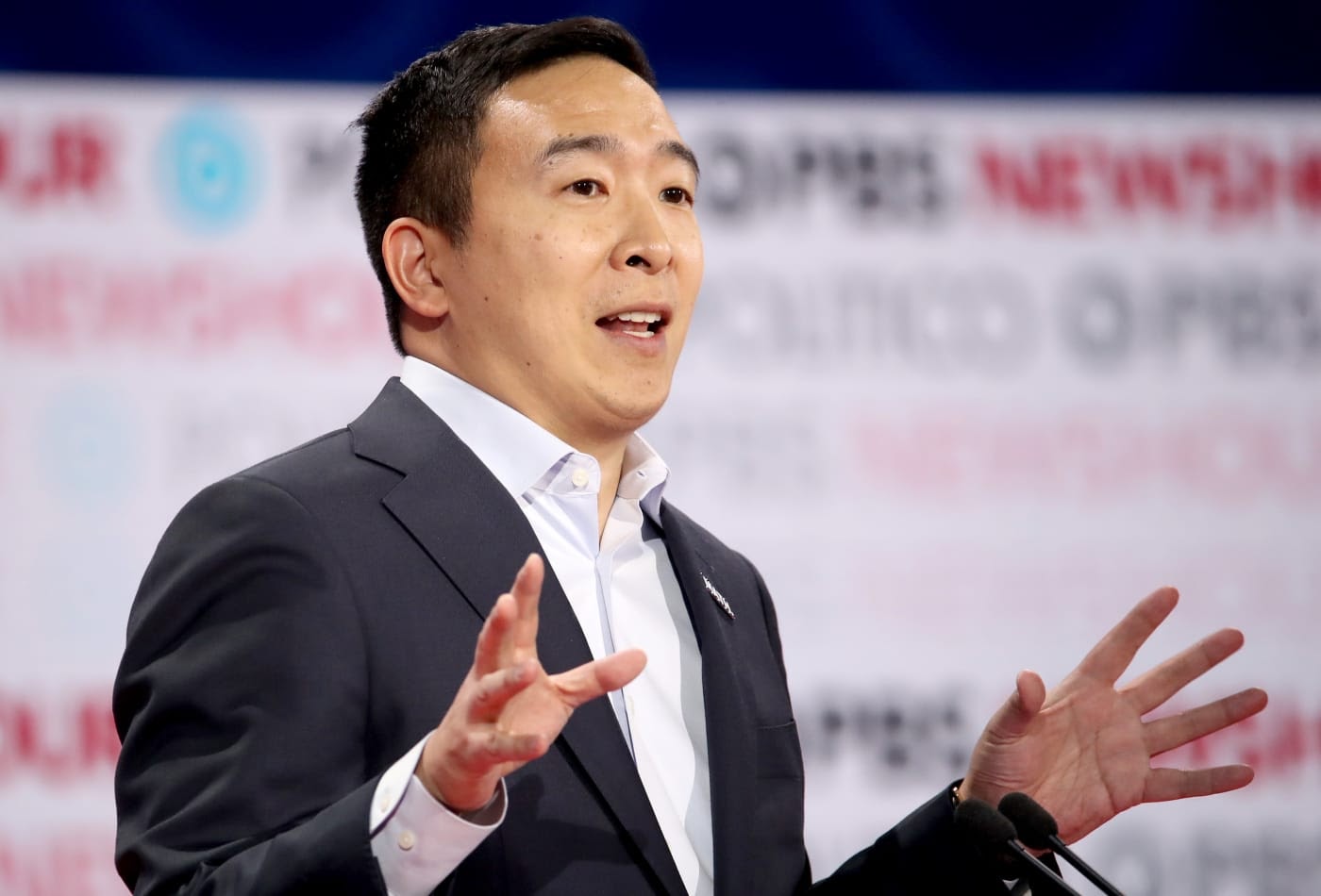
Andrew Yang
Bitcoin and crypto's biggest proponent in the 2020 race has easily been Andrew Yang, who is also known for being the first major Democratic candidate of Asian descent. Indeed, Yang believes that cryptocurrencies have "high potential" and he believes that Bitcoin can't be held back by regulations.
Indeed, Yang has also proposed the creation of a national framework for cryptocurrency as opposed to the current "hodgepodge of state-by-state treatments", saying that it's "bad for innovators who want to invest in this space".
According to the proposal published on his campaign website, he believes that:
"Investment in cryptocurrencies and digital assets has far outpaced our regulatory frameworks in the US. We should let investors, companies, and individuals know what the landscape and treatment will be moving forward to support innovation and development. The blockchain has vast potential."
Elizabeth Warren
Back in 2018, Warren said in a Senate Banking Committee hearing that crypto is easy to steal and that many small investors were being scammed through initial coin offerings. She went on to say that "the challenge is how to nurture productive aspects of crypto with protecting consumers".
Later on, in response to a question about whether she was concerned about the swarm of ordinary citizens buying up Bitcoin, Warren expressed her concerns about "consumers getting hurt", saying that "we need a Fed that is engaged in watching where risk builds up in the system. That's the Fed's job --- that's not the job of American families."
Mike Bloomberg
Billionaire and former New York mayor Michael Bloomberg also feel that clear regulations are the way forward, saying in his financial reform plan that he believes in "providing a clear regulatory framework for cryptocurrencies".
All in all, we're a little disappointed about the amount of air time (or lack thereof) that the future of money has received in the 2020 race so far, but we'll keep our fingers crossed for 2024...
What do you think? Which one of these candidates do you agree with? Will there be an official digital US dollar anytime soon? Let us know what you think in the comments below.
If you enjoyed this article, you may also be interested in:
Cryptocurrencies mentioned in this article: