Key Takeaways
- The latest report by Chainanalyis—a blockchain analytics company—revealed a rise in stablecoin use in Russia after the Ukraine invasion by Russia.
- The report was released on the 12th of October.
The latest report by Chainanalyis—a blockchain analytics company—revealed a rise in stablecoin use in Russia after the Ukraine invasion by Russia, which has resulted in overburdening sanctions and inflation in the country. The report was released on the 12th of October. In it, details of the surge in stablecoin use in Russia are revealed. The share of stablecoin's exchange rate on major Russian services skyrocketed from 42% in January to 67% in March after the invasion. Interestingly, this has been the order of things since the invasion happened—it has continued to rise.
Read:Microsoft and Meta partnership brings Office 365 apps to the Metaverse
Russian stablecoin usage surged after Ukraine invasion
In an interview with Chainalysis, an unrevealed expert knowledgeable about regional money laundering recommended that Russia's withdrawal from the transboundary system SWIFT, presumably to see crypto get integrated into transboundary transactions and deals, with stablecoins as the most preferred option to achieve their price stability.
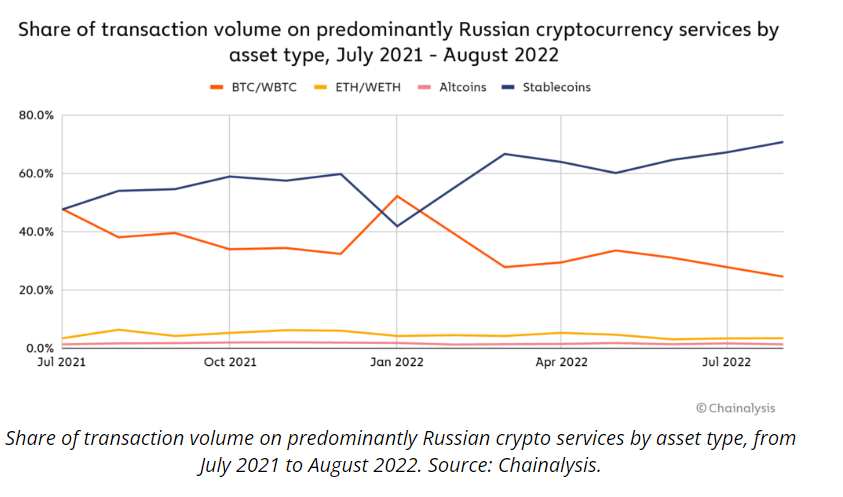
In the report, it was recommended that the rise in stablecoin implementation is a result of ordinary Russian citizens' exchanging the Ruble for stablecoins in a bid to guide the value of their assets amid the inflation that has broken out since the start of the war. Although some of this might be a result ofresult frombusinesses embracing cryptocurrency for foreign transactions, it might also be linked to the fact that ordinary Russian citizens exchange for stablecoins to safeguard their assets' worth, as shown earlier in the report.
Also, Chainalysis mentioned that it has discovered that Eastern Europe had the largest share of risky crypto operations, which is way higher than any other region globally in the last year. 18.2% of cryptocurrency operations in Eastern Europe are illegal, while Eastern Asia is the next highest at 15%, and Sub-Saharan Africa placed third. However, Sub-Saharan Africa had the biggest share of illegal cryptocurrency operations.
Chainalysis described the illegal activity as any transaction linked to an address associated with a risky entity, such as exchanges with little or no Know-Your-Customer (KYC) requirements. Let us know your thoughts about this surge for stablecoins in Russian.