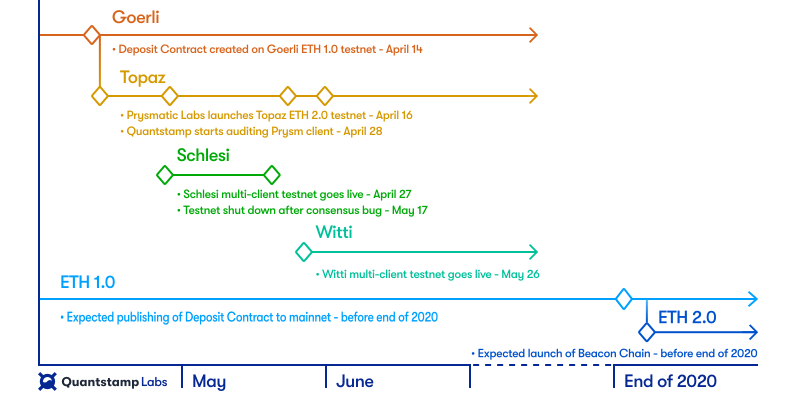
The beginnings of Ethereum 2.0 started during the last month of 2020.
The so-called Beacon Chain, or Phase 0, went live without major problems and all those who locked their Ether in it are on their way to becoming validators in the future.

The beginnings of Ethereum 2.0 started during the last month of 2020.
The so-called Beacon Chain, or Phase 0, went live without major problems and all those who locked their Ether in it are on their way to becoming validators in the future.
So, all seems to be on track to release Phase 1 of Ethereum 2.0 during 2021.
Of course, even after Phase 1, many are the steps to fully upgrade the Ethereum blockchain.
Some of these changes have the potential to break the way dApps and smart contracts work at the moment.
Also, the world of blockchain has not remained stale and many are the projects coming online to challenge Ethereum. All of these factors will impact the future of Ethereum.
Now that Phase 0 is done Eth 2.0 is moving towards Phase 1.
In Phase 0, the Beacon Chain was set up and people locked their Ether to become validators once the Ethereum blockchain transactions towards the Proof of Stake consensus algorithm.
In Phase 1, the Beacon Chain will contain all the information of the current Ethereum network, but it will become one of many chains.
Because the next step in the upgrade is to introduce sharding in to the Ethereum network.

Shards are individual chains capable of validating transactions, executing smart contracts, and coordinate economic activity.
The objective of sharding is to scale up the transactions per second (TPS) Ethereum is able to do.
Right now, Ethereum can do 15 TPS, once PoS has been fully implemented this is expected to jump to 1000 TPS.
Finally, each shard in Ethereum will be able to do 1000 TPS individually. In total Ethereum will launch 64 shards in the network.
Shards will be individually focused on certain use cases. For example, one shard will be for insurance, the other for exchanges, the other for non-fungible tokens, etc.
This way dApps that are not related won't have to share the resources of the network and be able to live separately in different shards.
Here things get complicated. First, the Beacon Chain won't do any transactions as it will remain as the record of Ethereum 1.0.
This means it won't be used by any dApps on the network.
Second, the Beacon Chain will serve as the coordination hub between the shards.
You see, sometimes a shard will need to communicate with another.
For example, if Aave is in shard 11 and Curve Finance in shard 17, then if I do a flashloan between them the Beacon Chain will handle the communication.
The problem is that while this operation is happening both shards, 11 and 17, will have to wait until the Beacon Chain has done the work.
Every time there is some cross-shard activity, parts of the network will slow down and the total amount of TPS Ethereum can do won't be 64,000.
It is unclear how much the final TPS will be since we don't have the shards and we don't know how they will be divided.
This is the main problem when sharding a blockchain, any cross-shard transactions become dependent on the speed of the main chain, in Ethereum the Beacon Chain, and the network suffers as a result.
Future developers of dApps will have to take into account in which shard their smart contract will be and what other shards their application will have to communicate with on a regular basis.
If cross-shard communication is too high it will become expensive to use. Since these types of transactions will cost more than regular ones to prevent too many cross-shard transactions.
This change alone has the potential to break how Ethereum works.
Because right now it is very easy to call smart contracts from a dApp since all live in the same network.
In Ethereum 2.0 this will no longer be the case and how this will affect developers remains unknown.
The world of blockchains has not remained the same since Ethereum began designing its upgrade.
Many new projects have already started applying the most important innovation projected for Eth 2.0. Right now. In a way, they have taken some of the spotlights away from Ethereum onto themselves.
Some of the most prominent are:

Cardano is a particularly interesting rival to ETH. Since its founder, Charles Hoskinson was also one of the founders of Ethereum.
In many ways, Cardano began because of the failings Charles Hoskinson saw at the start of Ethereum
One example of how Cardano is ahead is that its network already works using Proof of Stake.
It never used Proof of Work and staking in Cardano has been already live for a while and it is giving rewards right now. Something ETH has not even begun to do.
In 2021 Cardano will deploy its smart contract capabilities and begin attracting developers to its ecosystem.
Though Cardano has not implemented sharding, and that update will also bring many challenges to that project.

Polkadot is not only very interesting because it already uses PoS but also it is already sharded.
That is right, the Polkadot blockchain started as a sharded development ecosystem and right now these shards work together in the network.
Much like in Phase 1, each Polkadot shard can do 1,000 TPS.
Of course, the main chain of Polkadot coordinates cross-shard transactions and it has the same problems as post Phase 1 Ethereum.
But an important indicator of how sharding will work within Ethereum is Polkadot as developers in this network are already dealing with shards.

Another blockchain that is already sharded is Cosmos. It calls itself not a blockchain, but a network of blockchains already working together.
It was actually the first project to fully implement sharding and it has become the main example of this type of design.
Any dApp on Cosmos first has to choose in which shard to live and developers can actually start an entire blockchain for their dApp.
Once launched the main chain of Cosmos coordinates cross-shard transactions.
As we can see, while Ethereum 2.0. Has been cocking, blockchain already implemented its most important updates in other projects.
These will become the most important challengers of Ethereum 2.0. In the future and perhaps one of them will take its crown as the network with most dApps hosted on it.
Phase 2 is where the main net of Ethereum 2.0. Will be launched. This means Ethereum will fully leave behind Proof of Work and become entirely a Proof of Stake network.
All 64 shards will be live and working by that time and validators will replace miners for good.
In many ways, Phase 2 is the conclusion of the update to Ethereum.
It is projected to begin at the start of 2022 and it will last throughout that year finalizing in 2023.
So, the fully upgraded Ethereum 2.0. won't be ready until 2023.
Phase 0 has concluded as a success for Ethereum. The foundations of Ethereum 2.0. Have been placed and all seem to be going smoothly.
Yet, many are the challenges awaiting Ethereum as it begins implementing the next stages on its roadmap.
We have outlined the updates coming with Phase 1 while discussing some blockchains out there that already use sharding and Proof of Stake.
Blockchain will only chain more in 2021 and the question about:
Bitcoin or Altcoins: What Should You Invest in 2021?
Is in the mind of every investor.