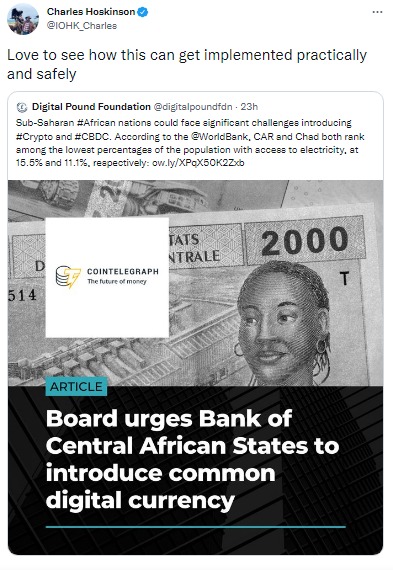
A central bank digital currency (CBDC), which will help modernize the payment system and improve regional financial inclusion, is about to be released by the Bank of Central African States. In a communication to the regional bank, the Bank of Central African States board urged this launch, according to a Bloomberg article. Charles Hoskinson retweeted the announcement of the introduction of digital currency, stating he would love to see its safe and effective adoption.
The Central African Republic (CAR) adopted a law in April saying that Bitcoin is acceptable as legal tender, although the country has not yet officially acknowledged the use of a central bank digital currency. In October 2021, the Nigerian central bank unveiled a digital currency. Nigeria became the first nation to acknowledge and adopt the eNaira CBDC. Project Khokha, a CBDC initiative launched in South Africa, is still being considered for deployment.
It is a problem that could harm the Central African Monetary Union. This claim was made by the Bank of Central African States in an effort to refute the CAR's decision to accept bitcoin as legal cash.
The proportion of people in the Central African Republic and the Republic of Chad who have access to electricity is extremely low. Each country's population has access to electricity at a rate of 12%. (Source: World Bank Data 2020). It will be challenging to introduce cryptocurrency and CBDCs to these countries in sub-Saharan Africa due to their energy deficit. Energy is required for mining and transfers
Nevertheless, with the debut of Nigeria's eNaira, other central banks in sub-Saharan Africa are about to issue digital currencies. Other countries include Equatorial Guinea, Cameroon, and the Republic of Congo. These countries are advancing the legal tender status of the virtual currency.