Infact, Twitter’s CEO Jack Dorsey announced <strong>his interest</strong> in the cryptocurrencies market in the African continent.
Individuals and small businesses in Nigeria, South Africa and Kenya account for most of this activity.
Why the High Rate of Crypto Acceptance in Africa?
Africa is undergoing an economic revolution that has nothing to do with banks and despite little sign of outdated economic policies being overhauled.
Monthly cryptocurrency transfers to and from Africa under $10,000 (€8,500) shot up by 55% over the past year, reaching a peak of $316 million in June.
These numbers, which are based on data from US Blockchain research firm Chainalysis, are likely to keep rising.
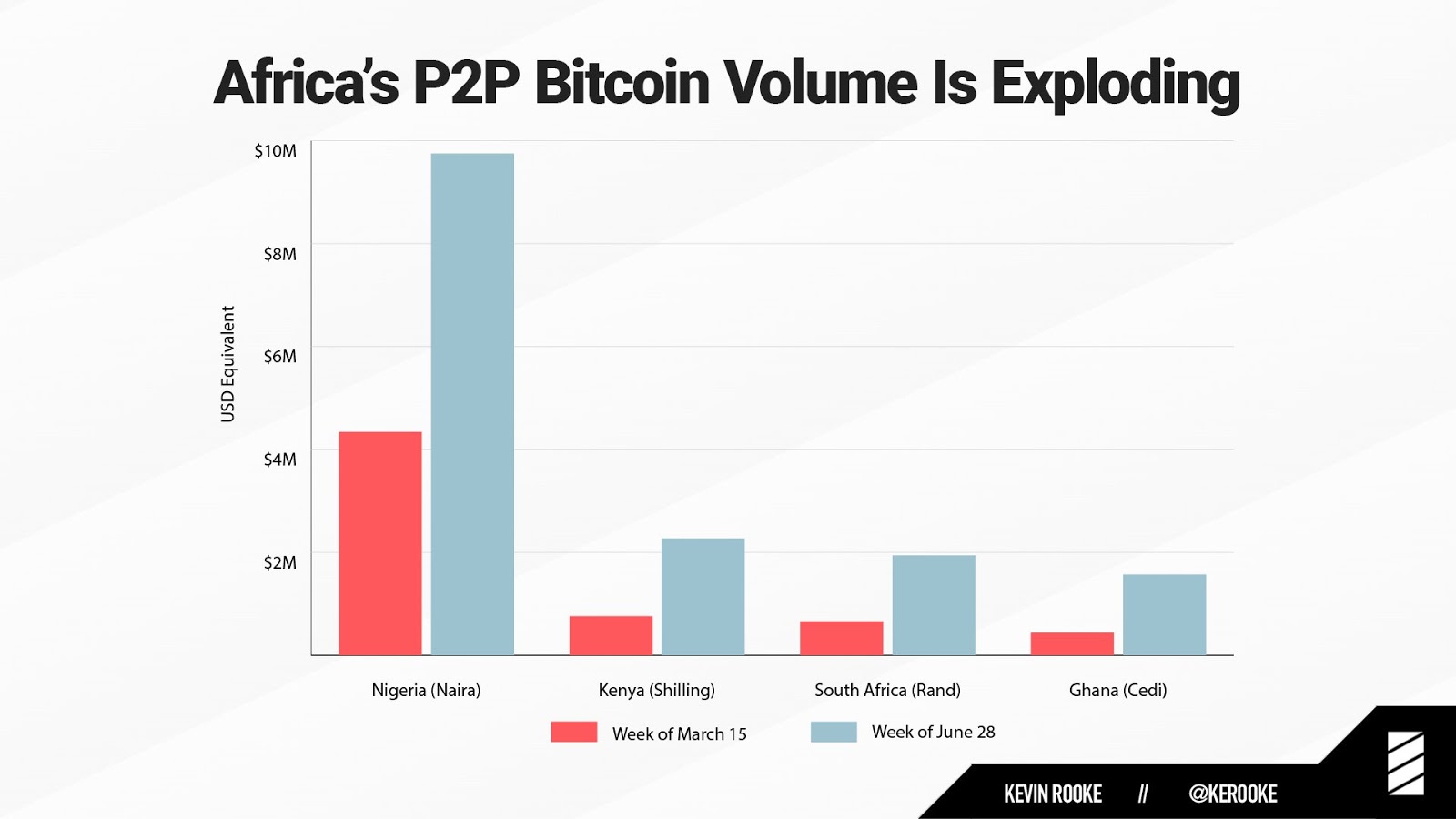
The adoption of Bitcoin is exploding in many countries in Africa
A Tweet from Kevin Broke:
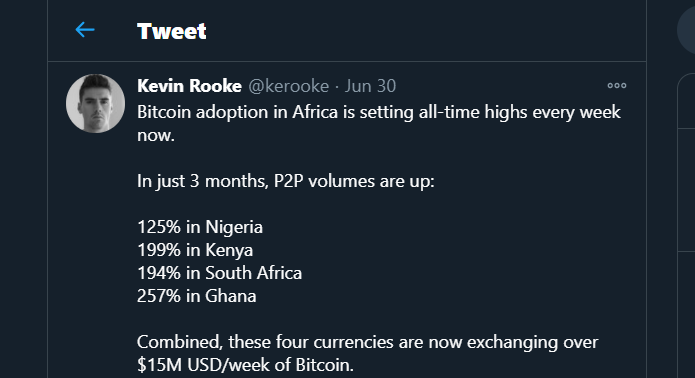
Based on the week of March 15 compared to Jun 28, you see a massive [rise in P2P Bitcoin volume](https://news.bitcoin.com/peer-to-peer-bitcoin-trading-tops-95-million-as-sub-saharan-africa-records-set-all-time-high/), especially in Nigeria.
The exciting thing about all of it is that this isn’t even with the majority of the congregating volume. There’s far more volume reported in groups on Telegram and WhatsApp.

Main Reasons for Widespread Adoption of Bitcoin by African States
Let’s go over the key factors fueling the uptake and use of Bitcoin by several Africans.
1. Africa’s Population
Africa has a population of more than 1.2 billion people, which means 1.2 billion potential adopters of crypto and Bitcoin. This would add a lot of buying pressure and demand for Bitcoin as an investment and store of value.
2. Young and Tech Savvy Population
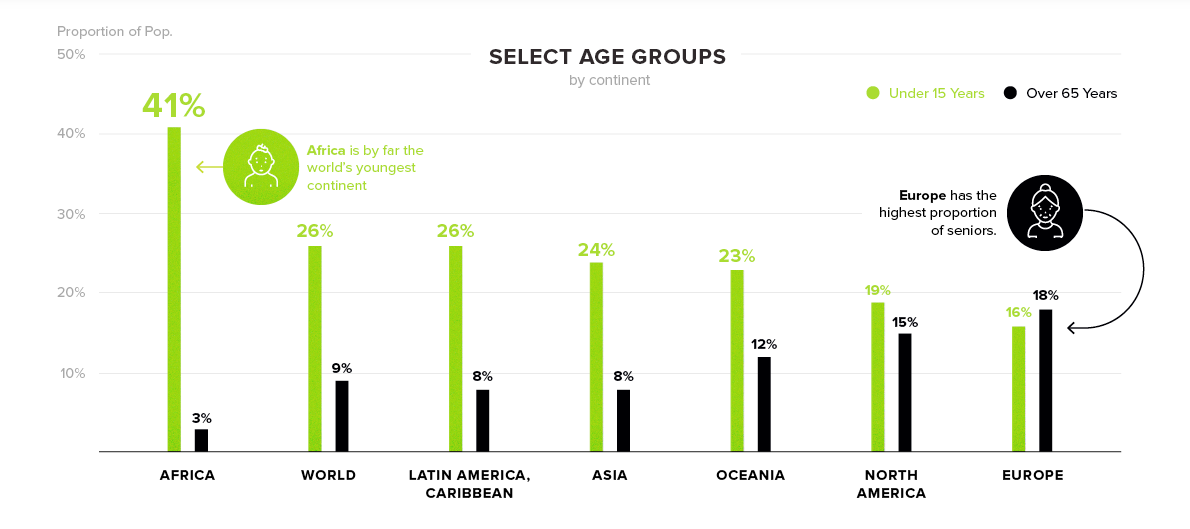
The majority of the 1.2 billion population consist of young and tech knowledgeable residents.This will make Bitcoin adoption simple as the youth possess the incentives to learn and adopt Bitcoin.
3. High Inflation Rate
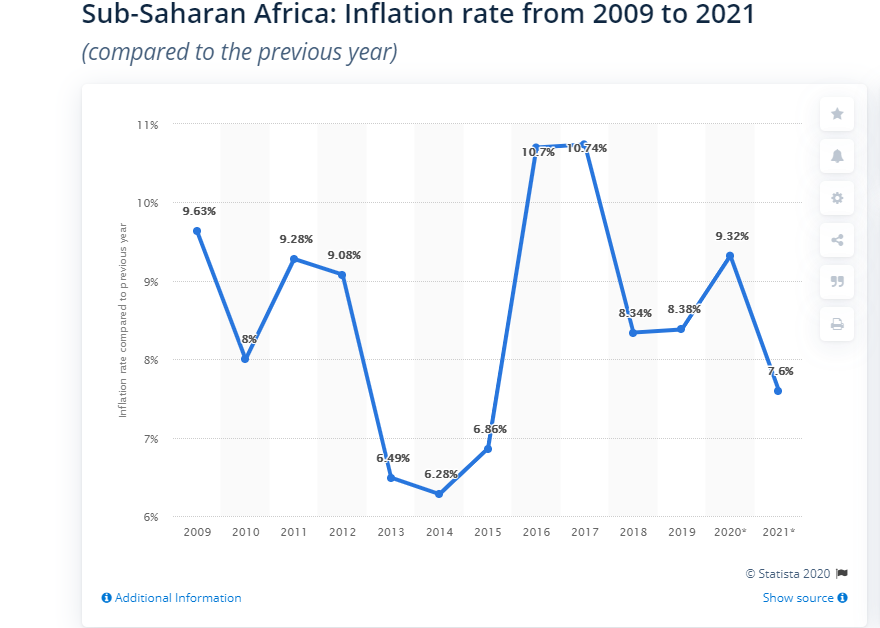
There’s considerable inflation in Africa relative to the rest of the world. Though Bitcoin is volatile, it’s a currency with a long term trajectory that makes the price tend upward. As a result, many prefer Bitcoin as a store of value.
4. Systemic Corruption
Another reason for the rise in Bitcoin use within African countries is corruption. This situation forces people to look for a fairer money system where they gain equal treatment regardless of their socio-economic class. According to a publication, [Nigerian banking corruption tops globally](http://ijecm.co.uk/wp-content/uploads/2015/04/3454.pdf).
5. Poverty
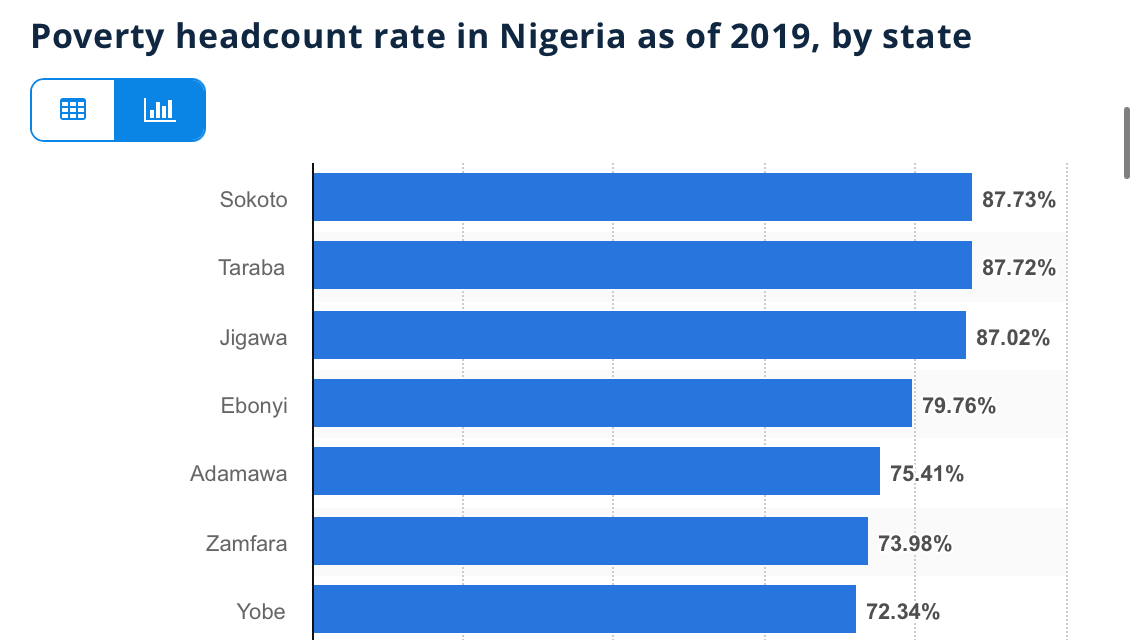
In 2019, the Nigerian states of Sokoto and Taraba had the largest percentage of people living below the poverty line. The lowest poverty rates were recorded in the South and South-Western states. In Lagos, this figure equaled to 4.5 percent, the lowest rate in Nigeria.
An individual is considered poor in Nigeria when has an availability of less than 137.4 thousand Nigerian Naira (roughly 361 U.S. dollars) per year. In total, 40.1 percent of the population in Nigeria lived in poverty.
6. Youth Unemployment
African youths consider the Bitcoin trading market as a new job niche. In reality, cryptocurrency use in the continent is more than for obtaining a side income as would be expected in western countries.
This is instigated by the severe unemployment/underemployment rates. The youths are Africa’s greatest asset.
Also, Africa’s youth population is rapidly growing and expected to double to over 830 million by 2050.
If properly harnessed, this increase in the working age population could support increased productivity and stronger, more inclusive economic growth across the continent.
But today, the majority of youth in Africa do not have stable economic opportunities.
Of Africa’s nearly 420 million youth aged 15-35, one-third are unemployed and discouraged, another third are vulnerably employed, and only one in six is in wage employment. Youth face roughly double the unemployment rate of adults, with significant variation by country.
The problem is not just unemployment but underemployment, which peaks at just over half of youth in the labor force in low income countries.
Let’s consider Nigeria as an example:
In 2020, the estimated youth unemployment rate in Nigeria was at almost 14.2 percent. According to the source, the data are estimates from the International Labour Organization, an agency of the United Nations developing policies to set labor standards.
A. Employment in Nigeria
The youth unemployment rate refers to the percentage of the unemployed in the age group of 15 to 24 years as compared to the total labor force. Youth unemployment rates are often higher than overall unemployment rates, which is true in Nigeria as well: the general rate of unemployment was approximately six percent in 2018. One reason for this contrast is that many of the youth under age 24 are studying full-time and are unavailable for work due to this.
B. Education in Nigeria
Nigeria’s population has a large percentage of young inhabitants, and there is a high demand for educational opportunities for its young populace.
After severe cuts in governmental aid following a nationwide recession in 2016, Nigeria’s underfunded higher education system became the focus of ongoing student protests and strikes.
Other families have taken a different approach: Nigeria is the top country of origin for international students from the continent of Africa. For example, Nigeria sent over 12,600 students to the U.S. in 2017/18, the most of any African country.
Hence, it’s clear why people living in Africa are shifting focus on traditional means of earning to the world of cryptocurrency.
7. COVID Pandemic
In many African countries the majority of people earn their livelihoods through the informal econ- omy with little insurance against unexpected disruptions. At the same time many formal busi- nesses, especially small businesses, are running out of reserves to sustain themselves.
Over time, we saw recession and a full-blown financial crisis. Economic recovery measures typically happen after crisis triggers and humanitarian challenges have received some attention. This approach will not work with COVID-19 because unemployment, job losses and wealth depletion (asset stripping) had started to happen very early on, even before the health impacts.
The effects the coronavirus pandemic has had on Africa’s largest economy is starting to show in data.
Take a look below:
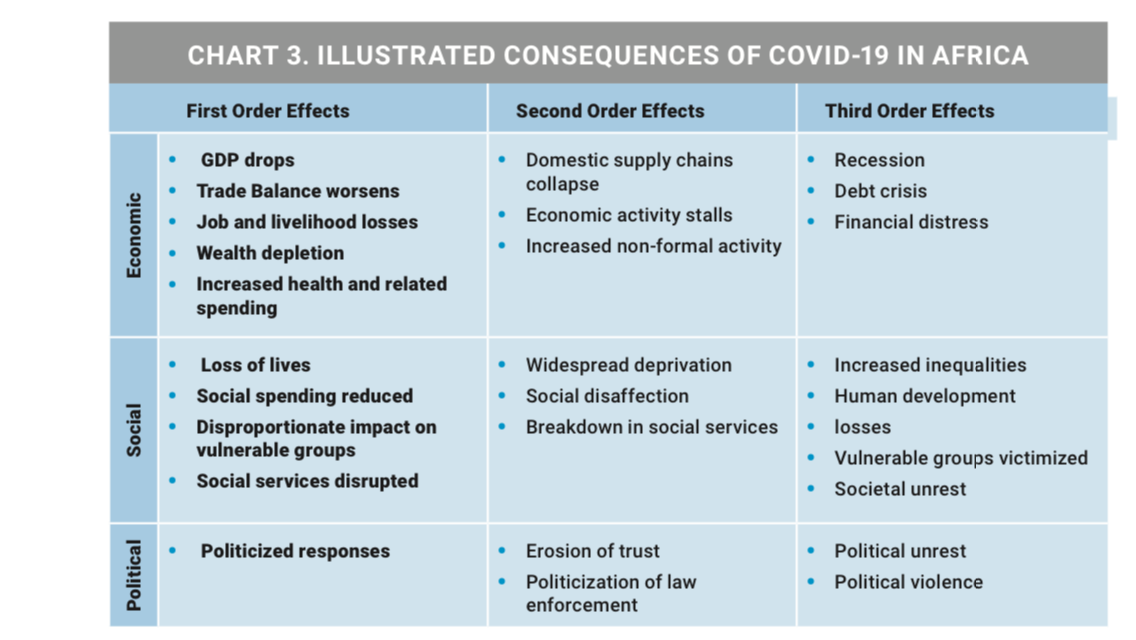
Kenya has witnessed job cuts across various sectors, and incomes of businesses and available working hours for staff have fallen significantly.These shocks and disruptions are likely to be felt both in the short and medium term.
Nigeria’s economy contracted by 6.1% year on year in the second quarter of this year, latest reports from Nigeria’s statistics bureau show. The dip follows thirteen quarters of positive but low growth rates. The -6.1% decline is also Nigeria’s steepest in the last 10 years.
8. Limited Banking Access
Back in 2017, Africa was regarded as an unbanked continent because 60 percent of the population did not have access to banking. Even the commercial banks faced a tough time meeting the demands of the country’s unbanked population. In addition to this, factors such as political instability, low-wage income, and sheer lack of financial knowledge.
Countries like South Africa responded to this scenario differently; they began to adopt a digital payment system for seamless, and uninterrupted financial trading. The adoption of new-age digital currency, Bitcoin changed the entire stance of financial instability as people had knowledge about finance
9. Middleman Scams
Middleman scams refer to a cyberattack where a hacker obtains sensitive information transmitted between two other parties online. The man-in-the-middle is normally an unauthorized third party who intercepts a conversation or transaction between two other parties.
This type of fraud is easily accomplished using unsecured public WiFi networks or poorly protected home networks. It can also be carried out by installing malware on the target’s computer.
To reduce the risk of man-in-the-middle scams, many resort to Escrow Peer-to-Peer crypto exchanges for transactions, which are otherwise faster and more reliable sources of exchanging, transferring, and buying various types of currencies.
Adoption Cryptocurrency in Nigeria
Nigeria’s Finance Ministry is reportedly in talks with the country’s securities regulator to develop a new framework for blockchain and cryptocurrencies.
A move that could further accelerate the adoption in Africa’s largest economy. Business day, a Nigerian market intelligence publication, recently noted that Finance Ministry adviser, Amstrong Takang speaking at an industry event
“Digital assets are recognized as commodities and governed by appropriate securities law in Nigeria following the SEC’s stunning edict on the matter back in September”.
At the time, the SEC said it’s role was to regulate this new asset class, not hinder adoption or innovation.
According to the SEC Nigeria, Bitcoin (BTC) and other cryptocurrencies are witnessing adoption in Nigeria, as the country struggles with capital controls, devaluation, and new protests targeting police corruption.
Nigerian officials appear keen on adopting blockchain, with hopes of generating $10 billion in revenue from the new technology by 2030.
Adoption of Cryptocurrency in South Africa, Kenya, and Ghana
South Africa, Kenya, and Ghana are listed in the report among the top 10 countries where “cryptocurrency” is most searched on Google. Economic challenges work both ways, as the digital divide slows the adoption of cryptocurrency while high financial fees make virtual currencies an attractive alternative.
These countries are some of the most promising regions for the adoption of cryptocurrencies.
This is due to its unique combination of economic and demographic trends. While the overall adoption is relatively low, the potential is enormous, the growth is rapid, and the development is likely to become defining for the cryptocurrency industry going forward.
There is a surprising fact which unveiled that there is a specific population in South Africa who are using Bitcoin to buy things, they are the millennials specifically people born from 1981 to 1996. The adoption of Bitcoin in South Africa and its growth is unprecedented.
Ghana went further to confirm that it is on the hunt for a Central Bank Digital Currency (CBDC). The Bank of Ghana’s deputy governor, Dr. Maxwell Opoku-Afari, recently revealed that the country’s central bank remains committed to piloting a national digital currency.
Despite the crypto adoption and interest in CBDC, Ghana is yet to develop regulations for the digital currency industry. The country’s Securities and Exchange Commission (SEC) proposed licensing of cryptocurrencies as a legal tender in January 2019. This came after investors lost their funds to a crypto startup.
However, not much has come from this proposal. Crypto traders still operate in a gray area as the government has not introduced regulations.
Conclusion
The growth potential of Crypto and Bitcoin in Nigeria shows there’s so much more in stock. In the absence of constraints, such as lack of enabling amenities the adoption rate will be much faster. For more on cryptocurrency in Nigeria, check out this article: <strong>The Legal Status of Cryptocurrency in Nigeria</strong>.