How could a digital version of the world's de facto fiat money work? What would it mean to have a digital version of the world's primary reserve currency? And what would a digital version of the United States dollar (US dollar) look like to begin with?
These questions and more have increasingly dominated the discourse in the global blockchain and cryptocurrency industry --- especially since China announced in early 2020 that it was already piloting its own version of a digital currency.
US dollar vs the pandemic

Source: marketwatch.com
Discussion around the need for a digital dollar has also wended its way into the United States' 2020 presidential race, no less because of the ongoing COVID-19 pandemic which has caused at least one in five American workers to lose their jobs. 30 million American workers currently receive unemployment benefits from the government as of late July 2020.
To make matters worse, the gap in access to financial services (e.g. not having a bank account) has made it especially challenging for the government to disburse funds to those in need.
These challenges led US lawmakers to propose the introduction of a limited form of "digital dollar" --- one that would allow US citizens and businesses to open accounts directly with the Federal Reserve (the country's central bank) to make it easier for the government to send money to those who need it.
Experts believe that these proposals are an encouraging sign and that they could signal a growing receptiveness to digital currencies. But will it all be too little too late?
Meanwhile...

Source: kucoin.com
The USDT, a privately-issued backed by actual assets, is not only the most popular "digital dollar" at present but also the fourth largest cryptocurrency in the world by market capitalisation.
The token is issued by Tether Limited, which is also known for two of its other fiat-backed tokens, i.e. the "digital euro" or EURT. And the "digital offshore Chinese yuan" or CNHT.
Fiat-backed tokens, which are also widely referred to as "stablecoins", are assets that are pegged 1:1 to their associated real-world assets. As such, stablecoins such as the USDT tend to be favoured by investors and traders as both a transaction tool and store of value due to their perceived stability, simplicity and familiarity.
As blockchain fintech leader Charles Cascarilla pointed out during a recent US senate committee hearing, stablecoins are the next evolution of the dollar and the existing banking system will inevitably be disrupted by digital currencies.
Also at the hearing was Chris Giancarlo, head of the Digital Dollar Project, who said that since most of the world's major commodities are priced in dollars, it is imperative that the dollar becomes programmable and digital in order to keep up with them.
The Digital Dollar Project
Source: Digital Dollar Project white paper
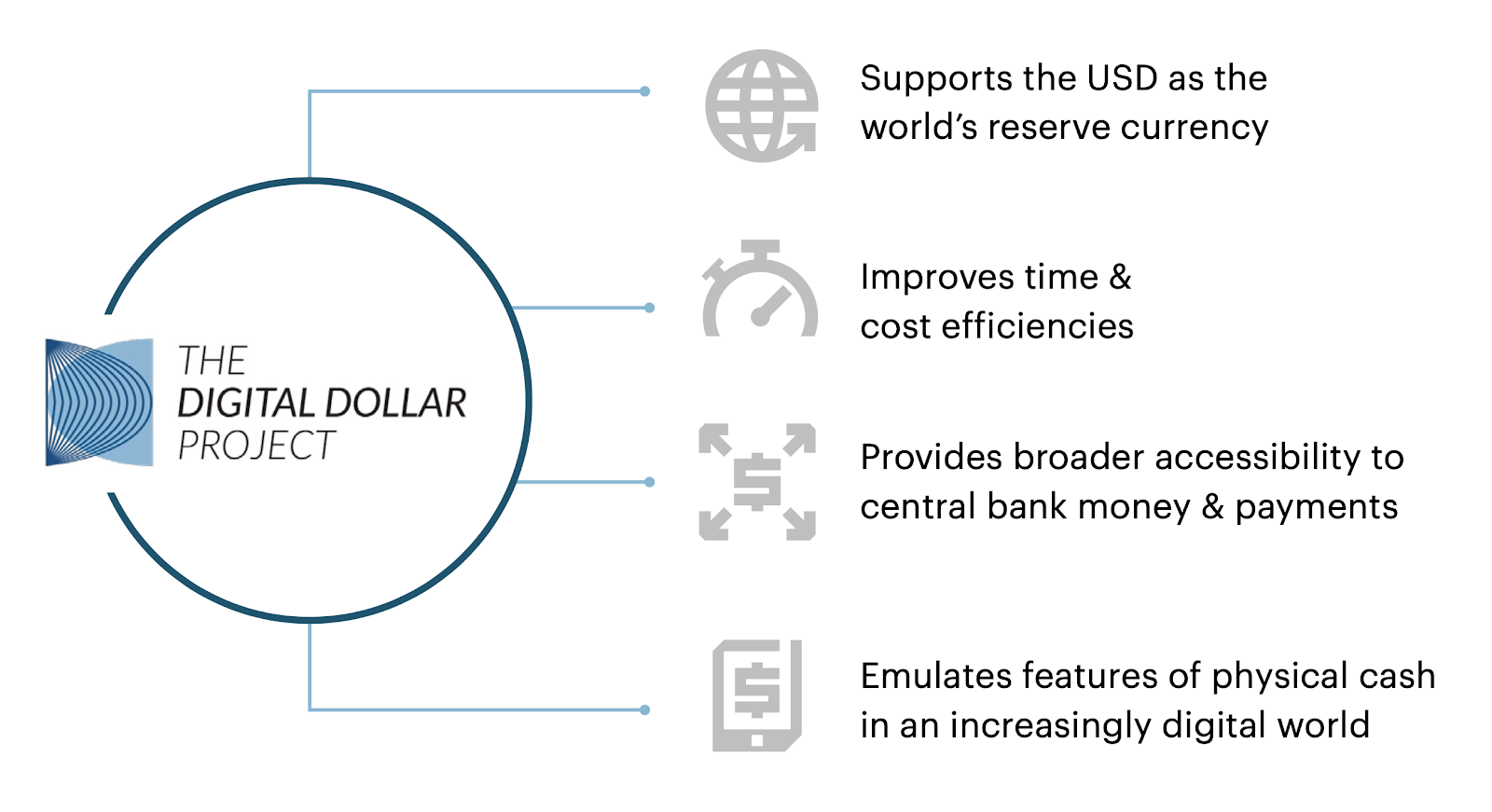
The Digital Dollar Project is a project spearheaded by the Digital Dollar Foundation and Accenture that aims to explore the creation of a central bank digital currency (CBDC) in the United States.
According to them, a tokenized US dollar would not only help maintain the economic stability of the US dollar. But also offer new market opportunities, broader accessibility, reduced costs, and increased efficiency.
The project believes that a tokenized form of the US dollar could:
- Operate alongside existing fiat currencies;
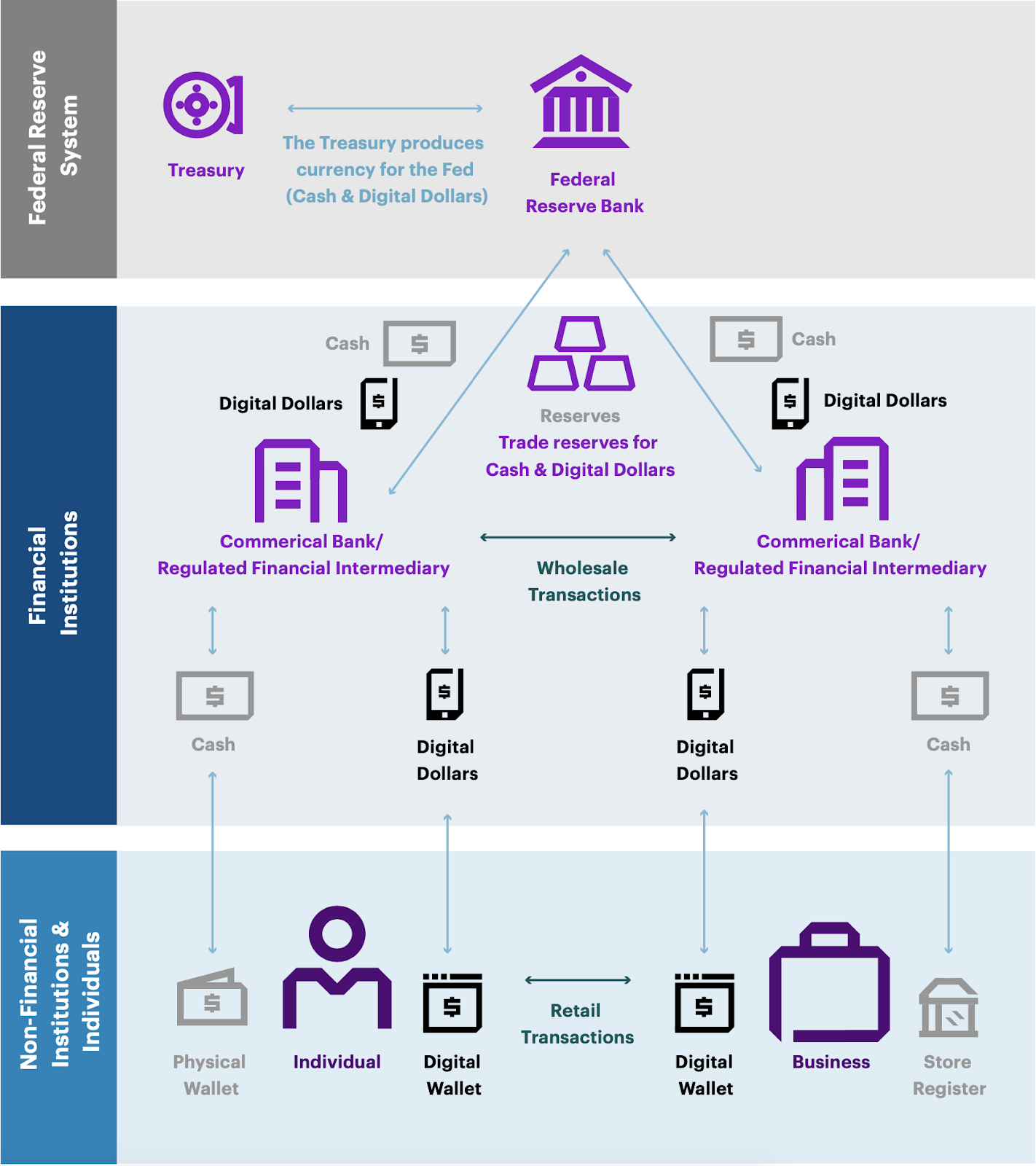
- Be distributed mainly through the existing two-tiered monetary system comprising commercial banks and regulated money transmitters;
- Combine cash-like properties with benefits provided by existing account-based payment mechanisms; and
- Run on new transactional infrastructure such as systems informed by distributed ledger technology.
Furthermore, it believes that a tokenized CBDC offers the opportunity to "customise" money. Which is to say that this technology could be configured and potentially reconfigured to meet critical functional requirements.
What might a Digital Dollar look like?
Source: Digital Dollar Project white paper
Here are the characteristics of the Digital Dollar Project's proposed model for it.
- Tokenization: Will be a tokenized form of the US dollar
- Third form of currency: Will operate alongside existing fiat currency and commercial bank money. It will mirror many properties of physical money, including its ability to work alongside existing account- based systems
- Maintenance of the two-tiered banking system: will be distributed through the existing two-tiered architecture of commercial banks and regulated intermediaries
- Privacy: Will support a balance between individual privacy rights and necessary compliance and regulatory processes. Decided upon by policymakers and ultimately reflecting the jurisprudence around the Fourth Amendment
- Monetary policy neutral: Will not impact the Federal Reserve's ability to affect monetary policy. And control inflation could act as a new policy tool
- Technology decisions and design choices driven by functional needs. The policy and economic requirements of a digital dollar will inform both the underlying technology and ultimate design choices
- Future proofing the architecture through flexibility: The chosen technological architecture will offer the flexibility to adapt configurability based on policy and economic considerations
- Continued private sector innovation: Will act as a catalyst for innovation and will not be antithetical to the development of private sector initiatives
What do you think? Will the US government implement