What is Internet of Things (IoT)?
The Internet of Things (IoT) refers to a network of devices that can perform tasks or exchange information without requiring any human aid or support. These IoT devices are usually equipped with sensors that capture data upon pre-established conditions.
The meaning of IoT has evolved as new technologies emerge. Once, the thought of connecting everyday appliances to the Internet was only possible in sci-fi movies. Today, this technological advancement has become a reality and slowly being embraced by large groups.
More and more innovators have consciously taken advantage of IoT to create more efficient systems. People do it by integrating smart devices and consumer appliances that are able to interact with each other. This is the very essence of smart living, which lies in the concept of smart cities, homes, and devices. But how did we get to this reality of devices making their own decisions? Perhaps a look at the history of IoT would help to understand this progress.
History of IoT
The first significant development that laid a framework for IoT started with the advent of the Internet.
The Internet, as we know it today, started as part of a project organized by the Defense Advanced Research Projects Agency (DARPA) in 1962. One of the researchers of MIT -- Lawrence Robert put together a plan for the "Arpanet" in 1969.
His presentation at DARPA got good engagement. However, it took another ten years before businesses began to adopt the use of the Arpanet(*). This delay was because the architecture for connecting one computer to another through a network model was not yet finalized.
(*)Arpanet: later became known as the Internet
In 1999, Kevin Ashton, while making a presentation at Procter & Gamble, stated his vision for IoT. He noted that humans usually initiate most of the data captured by our computing devices. Saying that human nature makes unable to account for everything, or capture information accurately, as at when needed.
He envisioned a scenario where devices will be able to obtain information themselves. They can also communicate with one another, without human inputs. This arrangement would save time, energy, and resources, as the processes would be more accurate.
Blockchain application examples of Internet of Things
The concept of the Internet of things, when applied on a blockchain platform, has tremendous possibilities. We would examine some areas where blockchain technology can aid in the development of IoT.
Here are some Internet of Things examples:
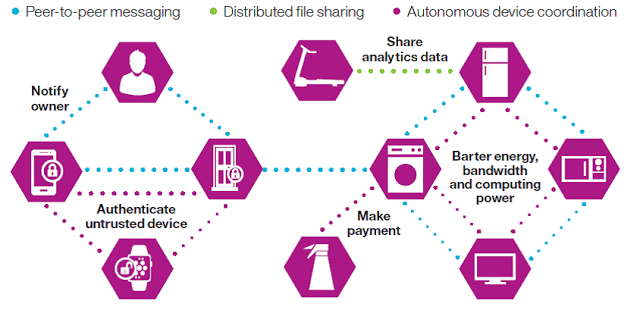
Smart homes: This concerns the use of IoT devices by individuals for personal use. IoT is quite popular in building smart homes. For example, a smart home would allow owners to program the water heater or coffee maker when he wakes up.
You can make the fridge to send a notification when some items are out of stock. You can also set up the oven to preheat. All these commands can be inputted via smart contracts in a unique blockchain. Middle to upper-income groups who want the ease of living without employing much domestic staff are the ones who favor IoT the most.
One of the significant advantages that blockchain offers IoT is the robust security architecture that makes it difficult for authorized third parties to make alterations. Its use on a blockchain platform can help to alleviate IoT security concerns, as data will be decentralized, and execution is done only via smart contracts.
Credits:blockchain.intellectsoft.net
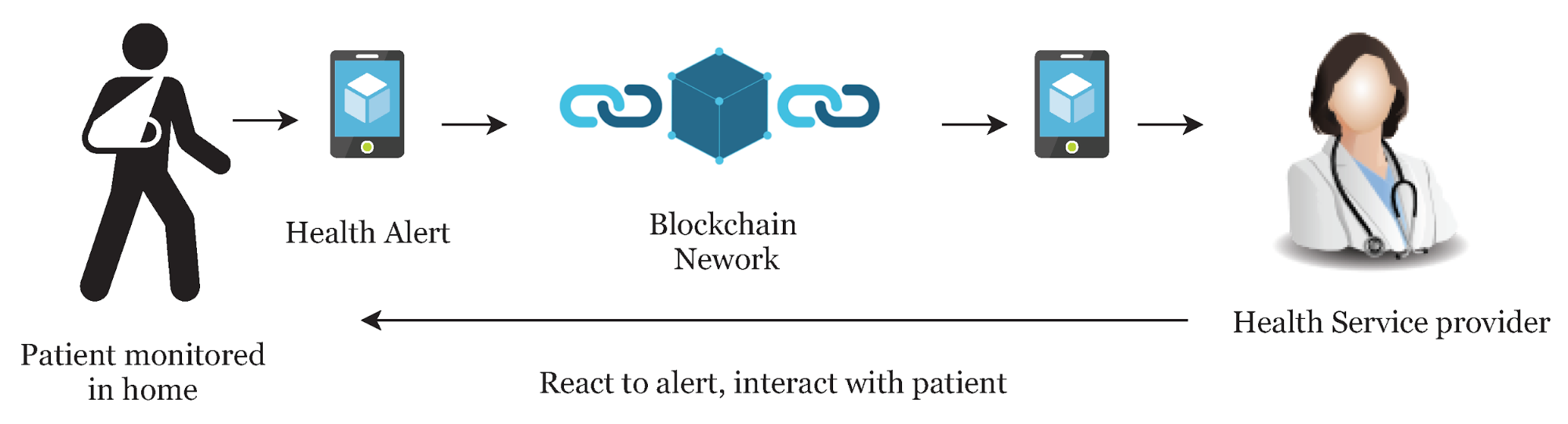
Healthcare: We discussed in detail the application of blockchain technology in health care management in our previous article. IoT blockchain application for healthcare, on the other hand, more focuses on interactions that IoT devices capture. IoT devices in healthcare is also the Internet of Medical Things.
The Internet of Medical Things aims to reducing manual processes in the delivery of healthcare services. Beyond using smart devices, some health centres have started using smart beds, which can tell when a patient is on the bed and when he is attempting to get up. These beds can also adjust themselves to give the necessary comfort and support patient needs.
Blockchain platform can connect all these to work efficiently and exchange information. A significant advantage of IoT devices is the way they operate to meet the patients' medical needs. They are also very suitable for providing healthcare to senior citizens and medical conditions that require constant daily supervision.
credits:www.mdpi.com
Manufacturing: This is one of the application of internet of things in an industrial setting. IoT enables seamless integration of various equipment and processes involved in the production process.
It also collects data to schedule maintenance of equipment and replacements. All these can be done effectively through smart contracts, a feature that is embedded in blockchain technology. This arrangement will lead to improved product quality, and quick response to correct any defects in final products.

credits:nist.gov
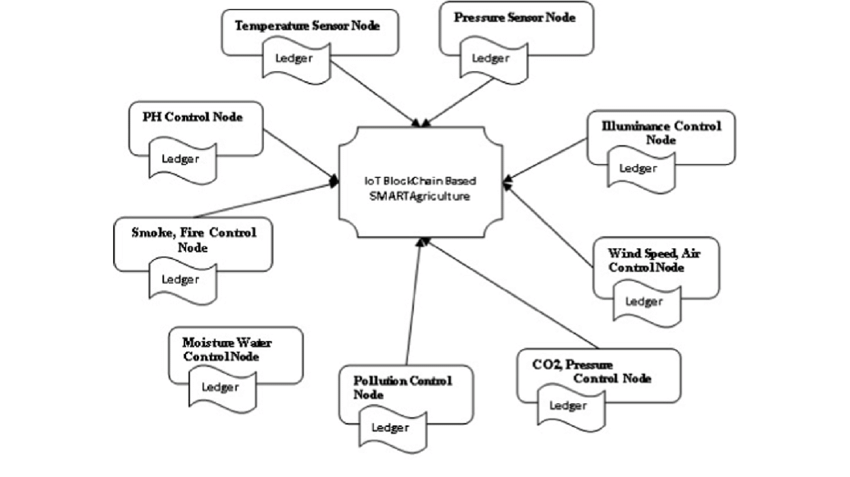
Agriculture: Most large farms already use machines and equipment because of the scale of their production. The more advanced farms are deploying IoT devices to automate a lot of their farming processes.
A blockchain designed IoT architecture will work in a way that each sensor becomes a node (i.e., there will be a node for wind control, water, lighting, ph level, etc.) Each of these sensors/nodes captures data, and then transmit it on the blockchain. The Smarts contracts feature allows these IoT devices to respond quickly, based on established parameters.
credits:researchgate.net
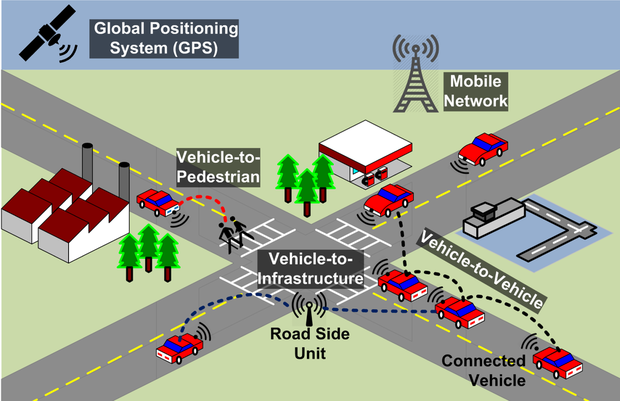
Transportation: Most developed countries are already using IoT devices in transportation systems and traffic controls. With IoT enabled traffic monitoring systems, we will be able to get real-time data on traffic situations and offer an alternative route that will ease traffic congestion.
Imagine if a large percentage of people use GPS, and we input our destinations in a GPS mapped by the city. Each user would represent a node on the blockchain platform. Each time a person inputs a new destination, a new block appears in the network.
The data captured by the IoT devices at various locations is also updated on the blockchain platform. Thanks to smart protocols, the user will receive directions in real-time on the best route suitable. IoT devices can also applicable in parking management, such that before you get to your destination, the GPS has already notified you of the closest parking spot, based on real-time data.
Credits:medium.com
The use of blockchain technology in the Internet of Things is one of the most profound shifts that would impact every single individual. From using IoT devices to build smart homes, wearing smartwatches for health monitoring to manufacturers and farmers alike, the list is indeed endless and all embracive.
Many might not know this, but the frontier of the IoT future is already being realistic with the creation of the Internet of things cryptocurrency (IOTA), which the founders envisioned will be the default currency that would enable device interoperability.